✓ Added to cart!
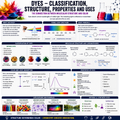

Chemistry of Dyes – Structure, Color & Molecular Properties
Chemistry of Dyes – Structure, Color & Molecular Properties
Color surrounds us every day—from clothing, food, artwork, biological stains, and cosmetics to advanced medical imaging, analytical chemistry, and modern materials science. But why do molecules appear colorful? Why do small structural changes dramatically alter color? And how does molecular structure determine the wavelength of light that a substance absorbs?
This comprehensive High School Chemistry resource introduces students to the fascinating science of dyes while building a deep understanding of organic chemistry, molecular structure, spectroscopy, and electronic transitions.
Students discover how conjugated π-systems, chromophores, auxochromes, and molecular orbitals determine the visible appearance of molecules. The resource connects fundamental chemistry with real-world applications in biotechnology, medicine, engineering, sustainable materials, food science, and industrial chemistry, making abstract concepts accessible through authentic scientific contexts.
Product Description
The unit begins with the fundamentals of color formation and visible light. Students investigate reflection, transmission, absorption, and complementary colors while learning how molecular structure influences the interaction between light and matter.
Learners then explore conjugated π-electron systems, HOMO-LUMO theory, π→π* transitions, and n→π* transitions to understand why increasing conjugation shifts light absorption into the visible spectrum.
A major focus is the classification of dyes. Students compare natural dyes—including anthocyanins, carotenoids, and indigo—with synthetic dye families such as azo dyes, anthraquinone dyes, and triphenylmethane dyes. Through structure analysis they identify chromophores, auxochromes, and structure-property relationships that explain molecular color.
Additional learning modules investigate spectroscopy, dye stability, molecular design, textile chemistry, food chemistry, biotechnology, analytical chemistry, and environmentally responsible dye development. Students evaluate modern industrial applications while strengthening scientific reasoning, molecular modeling, and analytical thinking.
The interdisciplinary approach makes this resource an excellent fit for advanced chemistry, STEM education, Honors Chemistry, and AP Chemistry enrichment.
What's Included
- complete instructional unit
- printable classroom lessons
- student reading passages
- scientific diagrams
- inquiry investigations
- molecular structure analysis
- spectroscopy activities
- higher-order thinking questions
- assessment tasks
- answer keys
Learning Modules
- Color Chemistry
- Visible Light
- Light Absorption
- Complementary Colors
- Chromophores
- Auxochromes
- Conjugated Systems
- HOMO-LUMO Theory
- π→π* Transitions
- n→π* Transitions
- Natural Dyes
- Synthetic Dyes
- Azo Dyes
- Anthraquinone Dyes
- Indigo
- Spectroscopy
- Organic Chemistry
- Materials Science
- Biotechnology
- Sustainable Chemistry
Students Will Learn To
- explain why molecules appear colored.
- analyze conjugated molecular systems.
- identify chromophores and auxochromes.
- interpret electronic transitions.
- explain structure-property relationships.
- evaluate industrial dye applications.
- connect organic chemistry with modern STEM technologies.
Perfect For
- High School Chemistry
- Honors Chemistry
- AP Chemistry Enrichment
- STEM Education
- Organic Chemistry
- Materials Science
- Physical Science
- College Preparation
Why Teachers Love It
Teachers appreciate this resource because it transforms abstract molecular theory into highly visual, inquiry-based classroom learning. Students connect spectroscopy, organic chemistry, and molecular structure with authentic industrial applications while strengthening analytical reasoning and scientific communication. The ready-to-use format reduces lesson preparation while supporting rigorous STEM instruction.
FAQ
Which grade levels is this resource designed for?
High School Chemistry, Honors Chemistry, AP Chemistry enrichment, and advanced STEM courses.
Are answer keys included?
Yes. Complete answer keys are provided.
Which dye classes are explored?
Natural dyes, azo dyes, anthraquinone dyes, triphenylmethane dyes, indigo, anthocyanins, and carotenoids.
Does the unit include spectroscopy concepts?
Yes. Students investigate visible light absorption, electronic transitions, HOMO-LUMO theory, and molecular color.
Is this suitable for STEM education?
Absolutely. The resource integrates chemistry, materials science, biotechnology, engineering, and sustainability into one comprehensive instructional unit.

$24.99 – Buy now
PDF · Instant Download