✓ Added to cart!
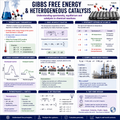

Gibbs Free Energy & Heterogeneous Catalysis
Gibbs Free Energy & Heterogeneous Catalysis
Why do some chemical reactions occur naturally while others require continuous energy input? Why can catalysts dramatically speed up reactions without changing their thermodynamic favorability? These questions are at the heart of chemical thermodynamics and modern industrial chemistry.
This comprehensive High School Chemistry resource introduces students to Gibbs Free Energy, enthalpy, entropy, reaction spontaneity, equilibrium, reaction kinetics, and heterogeneous catalysis through inquiry-based STEM learning.
Students first develop a conceptual understanding of energy transformations before exploring enthalpy, entropy, Gibbs Free Energy, and the Gibbs equation. Through calculations, energy diagrams, laboratory examples, and authentic scientific applications, they discover how temperature influences reaction spontaneity and chemical equilibrium.
The resource then connects thermodynamics with kinetics by introducing activation energy, reaction mechanisms, heterogeneous catalysis, and industrial catalytic processes. Learners investigate how catalysts lower activation energy while leaving equilibrium and Gibbs Free Energy unchanged.
Throughout the unit, mathematical modeling, scientific reasoning, and problem-solving are combined with engaging real-world examples from chemical engineering, environmental technology, biotechnology, sustainable manufacturing, and industrial chemistry.
Product Description
The instructional sequence begins by introducing energy transformations, system boundaries, exothermic and endothermic reactions, and the role of energy in chemical change.
Students then investigate enthalpy, entropy, Gibbs Free Energy, and spontaneity through carefully scaffolded lessons. They analyze energy profiles, calculate thermodynamic quantities, and explore how temperature influences chemical reactions using the Gibbs equation.
A major focus of the unit is understanding the relationship between Gibbs Free Energy and chemical equilibrium. Learners perform quantitative calculations while interpreting equilibrium constants and predicting reaction behavior under changing conditions.
The second half of the resource introduces reaction kinetics and heterogeneous catalysis. Students investigate activation energy, catalytic surfaces, industrial catalysts, reaction pathways, and energy diagrams while learning why catalysts accelerate reactions without changing thermodynamic equilibrium.
Real-world applications include environmental engineering, industrial synthesis, sustainable chemistry, catalytic converters, chemical manufacturing, and modern process engineering, making this an engaging STEM resource for advanced chemistry classrooms.
What's Included
- complete instructional unit
- printable classroom lessons
- student reading passages
- scientific diagrams
- energy profile activities
- inquiry investigations
- calculation exercises
- assessment tasks
- higher-order thinking activities
- complete answer keys
Learning Modules
- Chemical Thermodynamics
- Enthalpy
- Entropy
- Gibbs Free Energy
- Gibbs Equation
- Reaction Spontaneity
- Equilibrium
- Standard Conditions
- Reaction Kinetics
- Activation Energy
- Heterogeneous Catalysis
- Catalytic Mechanisms
- Energy Diagrams
- Industrial Chemistry
- Chemical Engineering Applications
Students Will Learn To
- explain thermodynamic principles.
- calculate Gibbs Free Energy.
- interpret energy diagrams.
- predict reaction spontaneity.
- distinguish thermodynamics from kinetics.
- analyze catalytic mechanisms.
- solve quantitative chemistry problems.
- apply chemistry concepts to real-world STEM systems.
Perfect For
- High School Chemistry
- Honors Chemistry
- AP Chemistry Enrichment
- STEM Education
- Physical Chemistry
- Chemical Engineering
- College Preparation
- Advanced Laboratory Courses
Why Teachers Love It
Teachers value this resource because it transforms one of chemistry's most abstract topics into a logical and engaging learning sequence. Students connect mathematical models with authentic scientific applications while developing analytical thinking, quantitative reasoning, and scientific communication. The classroom-ready lessons save preparation time and support rigorous STEM instruction.
FAQ
Which grade levels is this resource designed for?
High School Chemistry, Honors Chemistry, AP Chemistry enrichment, and advanced STEM courses.
Are calculation exercises included?
Yes. Students practice Gibbs Free Energy calculations, equilibrium problems, and thermodynamic analysis.
Does the unit include heterogeneous catalysis?
Yes. Students investigate catalytic mechanisms, activation energy, industrial applications, and reaction kinetics.
Is this appropriate for AP Chemistry enrichment?
Absolutely. The depth of explanation and quantitative focus make it an excellent enrichment resource.
Are answer keys included?
Yes. Complete answer keys are provided.

$24.99 – Buy now
PDF · Instant Download