✓ Added to cart!
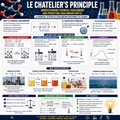

Le Chatelier's Principle – Understanding and Predicting Chemical Equilibrium
Le Chatelier's Principle – Understanding and Predicting Chemical Equilibrium
Chemical equilibrium is one of the most important concepts in chemistry because it explains how chemical systems respond to changing conditions. Whether studying industrial ammonia production, biological buffer systems, environmental chemistry, or laboratory reactions, students must understand how equilibrium shifts occur and why they are essential in both science and engineering.
This comprehensive High School Chemistry resource provides a complete introduction to chemical equilibrium while developing conceptual understanding, mathematical reasoning, scientific analysis, and inquiry-based problem solving. Students learn not only what equilibrium is, but also why equilibrium systems respond predictably to changes in concentration, temperature, pressure, and catalysts.
Designed for advanced secondary chemistry classrooms, the unit combines chemistry, engineering, industrial applications, and STEM education through engaging investigations and authentic scientific examples.
Product Description
Students begin by exploring reversible reactions and dynamic equilibrium before learning how reaction rates change as equilibrium is established. The unit then introduces equilibrium constants, the law of mass action, reaction quotients, and graphical analysis, helping students connect mathematical models with observable chemical behavior.
A major focus is Le Chatelier's Principle. Students investigate how chemical systems respond to disturbances in concentration, temperature, and pressure while learning to predict equilibrium shifts using scientific evidence rather than memorization.
Real laboratory demonstrations—including the chromate–dichromate equilibrium—allow students to observe equilibrium changes visually, while additional case studies explore esterification, industrial ammonia synthesis, carbonate equilibria, biological buffer systems, and other important equilibrium processes.
Scientific diagrams, inquiry investigations, quantitative exercises, graph interpretation, engineering applications, and higher-order thinking activities strengthen analytical reasoning while preparing students for advanced chemistry coursework and standardized assessments.
What's Included
- complete instructional unit
- printable classroom lessons
- student reading passages
- scientific diagrams
- inquiry investigations
- laboratory demonstrations
- graph analysis activities
- quantitative problem solving
- assessment tasks
- answer keys
Learning Modules
- Chemical Equilibrium
- Dynamic Equilibrium
- Reversible Reactions
- Le Chatelier's Principle
- Law of Mass Action
- Equilibrium Constants
- Reaction Quotients
- Concentration Changes
- Pressure Effects
- Temperature Effects
- Catalysts
- Chromate–Dichromate Equilibrium
- Esterification
- Buffer Systems
- Industrial Chemistry
- Engineering Applications
- Graph Interpretation
- Quantitative Chemistry
Students Will Learn To
- explain dynamic equilibrium.
- predict equilibrium shifts.
- apply Le Chatelier's Principle.
- calculate equilibrium constants.
- interpret reaction quotients.
- analyze equilibrium graphs.
- connect chemistry with industrial processes.
- apply quantitative reasoning to chemical systems.
Perfect For
- High School Chemistry
- Honors Chemistry
- AP Chemistry Enrichment
- STEM Education
- Physical Science
- Engineering
- College Preparation
- Advanced Secondary Science
Why Teachers Love It
Teachers value this resource because it transforms one of chemistry's most abstract topics into engaging, inquiry-based learning. Students build conceptual understanding through laboratory investigations, mathematical analysis, engineering examples, and real-world applications while developing scientific reasoning and problem-solving skills. The classroom-ready format significantly reduces preparation time while supporting rigorous chemistry instruction.
FAQ
Which grade levels is this resource designed for?
High School Chemistry, Honors Chemistry, AP Chemistry enrichment, and advanced STEM courses.
Does the resource include quantitative chemistry?
Yes. Students calculate equilibrium constants, analyze reaction quotients, and interpret equilibrium graphs.
Are laboratory activities included?
Yes. The unit incorporates classroom demonstrations and inquiry-based investigations.
Can this resource support AP Chemistry enrichment?
Absolutely. The mathematical and conceptual depth makes it an excellent enrichment resource.
Are answer keys included?
Yes. Complete answer keys are provided for classroom implementation.

$24.99 – Buy now
PDF · Instant Download