

✓ Added to cart
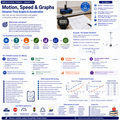


Describing Motion & Interpreting Graphs | Speed, Acceleration & Motion Graphs | Physics Unit | Grades 7–9
Physics Complete – Ready-to-Use Curriculu... · from $149.90 See bundle →
Describing Motion & Interpreting Graphs | Speed, Acceleration & Motion Graphs | Physics Unit | Grades 7–9
Describing Motion & Interpreting Graphs is a complete, no-prep physics unit for Grades 7–9: four double lessons (8 × 45 minutes) with teacher lesson plans, two reading passages, four print-ready worksheets, fully written answer keys, an assessment rubric and a 10-slide editable presentation — differentiated at three levels.
Guiding question: How can motion be recognised, represented and predicted from measured data?
Students move from everyday descriptions of motion to operational definitions of position, distance, speed and acceleration. Measurements, motion graphs and calculations are connected so that graphs are read as physical stories rather than decorative lines.
What's Included
- Teaching rationale and competency framework
- Complete lesson plans with timings for 4 double lessons (8 × 45 min)
- 2 detailed student reading passages
- 4 print-ready student worksheets
- Fully written solutions and an assessment rubric
- 20-point assessment with answer key
- 3 levels of differentiation: Foundation · Core · Extension
- Formula sheet and board summary
- 10 editable presentation slides (PPTX)
- Print and digital · US Letter and A4
The Four Double Lessons
- Motion needs a reference point
- Speed connects distance and time
- A graph tells the motion story
- Acceleration and safe stopping
Topics Covered
- Reference points and frames
- Distance, displacement and position
- Average and instantaneous speed
- Distance–time and velocity–time graphs
- Slope, gradient and interpretation
- Acceleration and deceleration
- Reaction distance, braking distance and road safety
Students Will Learn To
- use central quantities, concepts and laws accurately in scientific language
- formulate a testable question, control variables, analyse measurements and identify uncertainty
- present graphs, equations, models and experimental reports appropriately for the audience
- test physical claims, identify model limits and weigh technological or societal applications
Prerequisites & Equipment
Prior knowledge: proportional relationships; coordinate systems; converting common units
Equipment for the investigation: dynamics trolley or toy car, stopwatches, measuring tape
Perfect For
- Middle School Physical Science
- High School Physics
- Honors and enrichment courses
- Homeschool and independent study
- Sub plans and review weeks
- Lab-based inquiry units
- NGSS-aligned science classrooms
Why Teachers Choose This Unit
- Genuinely no-prep: open, print, teach
- Answer keys for every task, not just the hard ones
- Three differentiation levels built into the same lesson
- Hands-on investigation with realistic sample data included
- Editable slides you can adapt to your own sequence
- Model limits made explicit — students learn where physics stops, too
Created with AI assistance: ChatGPT (OpenAI) and Claude (Anthropic). All materials were reviewed and edited by a qualified teacher before publication.
Frequently Asked Questions
What grade levels is this unit for?
It is written for Grades 7–9. The Foundation / Core / Extension tasks let you use the same lesson across a mixed-ability class.
How long does the unit take?
Four double lessons, 8 × 45 minutes in total. Each double lesson can be split into two single periods.
Do I need laboratory equipment?
The core investigation uses: dynamics trolley or toy car, stopwatches, measuring tape. Sample data and fully worked results are included, so the unit also works without equipment.
What file formats do I get?
Editable Word documents for the teaching unit and worksheets and an editable PowerPoint presentation, delivered as an instant digital download.
$24.99 – buy now
PDF · instant download
🔒 Secure checkout · ♾️ reuse every yearFAQ about this resource
More Physics resources for Middle School
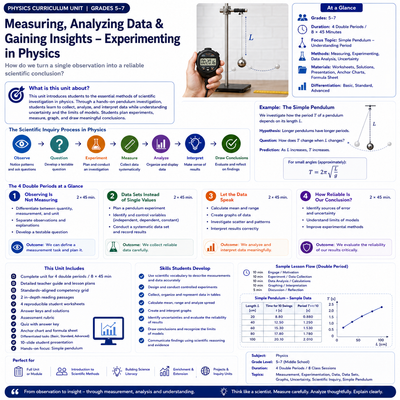
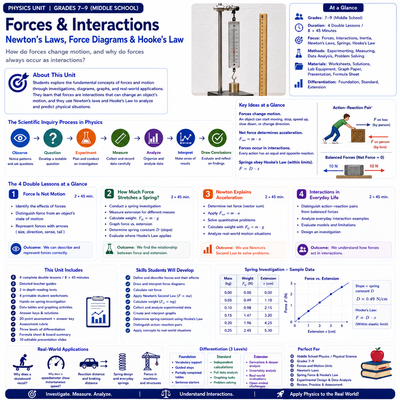
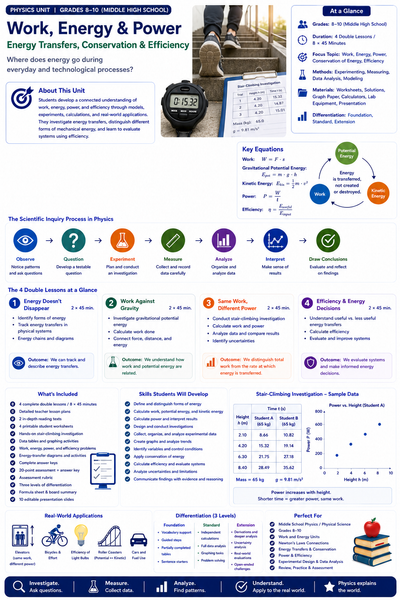

Review: Describing Motion & Interpreting Graphs | Speed, Acceleration & Mot...
Describing Motion & Interpreting Graphs | Speed, Acceleration & Motion Graphs... is a fully worked-out teaching resource for Physics at Middle School level (Grades 6–8). Its strength is that it is finished: worksheets, answer keys and teacher notes are all there, so a lesson can start without extra prep.
Teachers covering a topic at short notice, early-career teachers under planning pressure, and anyone picking up a cover lesson — and any situation where a lesson has to be ready today.
An editorial assessment of structure, scope and classroom use. It is not a customer review.