

✓ Added to cart


Chance & Events | Sample Space, Relative Frequency & Dice Experiments | Probability Unit | Grades 5–7
Chance & Events | Sample Space, Relative Frequency & Dice Experiments | Probability Unit | Grades 5–7
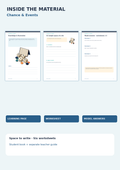
Chance & Events is a no-prep introduction to probability: six differentiated worksheets in a 12-page student book, plus a 7-page teacher guide with a four-phase lesson plan, differentiation notes and model answers.
Students predict, roll a die thirty times, pool the class data and then evaluate it. Along the way they learn to tell an outcome from an event and a sample space, classify events as certain, possible or impossible, turn a tally chart into relative frequencies, find out why a sum of 7 comes up more often than a sum of 2 with two dice, and take apart the claim that tails must come after five heads. The teacher guide is clear that small samples vary and a handful of trials proves nothing about a theoretical probability.
What's Included
- 12-page student book with six differentiated worksheets (Discover · Practise · Apply)
- Knowledge page with illustration and key text
- Image lab: describe, explain and link a picture to a key term
- Investigation and extension tasks
- Learning check, self-assessment and a personal learning route
- 7-page teacher guide: rationale, learning goals and a four-phase lesson (Engage · Explore · Practise · Reflect) with timings
- Differentiation and diagnosis notes for foundation, core and extension
- Model answers for all six worksheets and the image lab
- Print-ready PDF (A4; prints on US Letter with fit-to-page)
Worksheet Sequence
- Sample space of a die — outcomes, events and the set {1,2,3,4,5,6}
- Certain, possible, impossible — classifying events for one die
- Tally chart — recording thirty rolls with a partner
- Evaluate data — relative frequency and sampling variation
- Two dice — ordered pairs and why 7 is the most likely sum
- Check a misconception — independent coin tosses and the gambler's fallacy
Students Will Learn To
- distinguish outcome, event and sample space
- calculate relative frequency from experimental results
- test claims about random experiments and explain variation in short series
Perfect For
- Grade 5–7 math and pre-algebra
- Introductory statistics and probability units
- KS3 maths
- Math centers and hands-on data lessons
- Homeschool math
Why Teachers Choose This Unit
- A complete sequence, not a set of loose worksheets
- Every task has a written model answer
- Differentiated so the whole class works on the same goal with different amounts of support
- Illustrations used as discussion prompts, with facts checked against the text or a real model
- Plan 4–6 lessons and teach straight from the PDF
Created with AI assistance: ChatGPT (OpenAI) and Claude (Anthropic). All materials were reviewed and edited by a qualified teacher before publication.
Frequently Asked Questions
What do students need?
Standard six-sided dice (one per pair, two for the two-dice worksheet) and a coin.
Which grade does this fit?
It suits Grades 5–7. In Common Core states the content sits closest to the Grade 7 probability standards; use it earlier as enrichment. No official endorsement is claimed.
How long does it take?
Plan four to six lessons, including one lesson for the class experiment.
How is it delivered?
As an instant digital download after checkout. Nothing is shipped.
$19.99 – buy now
PDF · instant download
🔒 Secure checkout · ♾️ reuse every yearFAQ about this resource
More Math resources for Cross-Grade Resources


Review: Chance & Events | Sample Space, Relative Frequency & Dice Experimen...
Chance & Events | Sample Space, Relative Frequency & Dice Experiments | Proba... is a fully worked-out teaching resource for Math at Cross-Grade Resources level (Grades 5–7). Its strength is that it is finished: worksheets, answer keys and teacher notes are all there, so a lesson can start without extra prep.
Teachers covering a topic at short notice, early-career teachers under planning pressure, and anyone picking up a cover lesson — and any situation where a lesson has to be ready today.
An editorial assessment of structure, scope and classroom use. It is not a customer review.