

✓ Added to cart

Cursive Writing | Strokes, Letters a–z & Joining Words | Grades 2–3
Cursive Writing | Strokes, Letters a–z & Joining Words | Grades 2–3
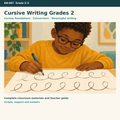
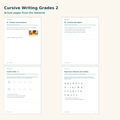
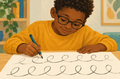
Cursive Writing Grades 2–3 is a cursive handwriting unit for Grades 2 and 3: a 60-page classroom material set and a 14-page teacher guide. Students first learn the movements that letters are built from, then each lowercase letter, then how to join letters into words. The goal is readable, fluent handwriting that students can use for their own writing. Pretty letters for their own sake are not the point.
The ten lessons begin with posture and movement, then baseline and letter height. Next come the stroke families of cursive. Undercurves swing up from the baseline, and overcurves arch over the midline. The oval family covers the round letters. Tall loops and descending loops come after that. Once students control these movements, they can build most letters from them. Lesson 8 joins letters into words. Lesson 9 deals with capital letters. Cursive capitals come in different forms, so the lesson is called Uppercase choices. Lesson 10 moves to fluent writing with real meaning. Alongside the lessons, every lowercase letter from a to z has its own page, where students practice a readable form and the exit stroke that leads into the next letter. An uppercase reference page helps students recognize and read capitals in cursive-style writing. A learning record lets students see their progress.
What's Included
- Classroom Material: 60 pages (PDF)
- Teacher Guide: 14 pages (PDF)
- 74 pages in total
- Editable DOCX text version (pagination may differ)
- Editable PowerPoint presentation (PPTX, editable text)
- Print-ready A4 PDF that prints on US Letter with fit-to-page
The 10 Lessons
- Posture and movement. Get ready to write with comfortable, fluent movement.
- Baseline and height. Keep letters on the line at the right size.
- Undercurves. The upward swing that starts many letters.
- Overcurves. The arch that rises over the midline.
- Oval family. Round letters built from one oval motion.
- Tall loops. Letters that rise above the midline.
- Descending loops. Letters that drop below the baseline.
- Joining words. Connect letters with readable joins.
- Uppercase choices. Capital letters and their common forms.
- Fluent meaningful writing. Write real sentences in cursive.
Plus 26 lowercase letter pages (a to z), an uppercase reference and reading page, and a student learning record.
Students Will Learn To
- Sit and hold the pencil in a way that supports fluent movement
- Form undercurve, overcurve, oval and loop strokes
- Write each lowercase cursive letter with a clear exit stroke
- Join letters into readable words
- Read and write cursive capitals and use cursive for their own sentences
Perfect For
- Grade 2 and Grade 3 handwriting lessons
- States and schools that include cursive in their handwriting expectations
- Grade 4 students who missed cursive and need a structured start
- A short daily handwriting routine or morning work
- Homeschool families teaching cursive
- UK and Australia: roughly maps to Years 3–4 in England and Years 2–3 in Australia, where joined handwriting is taught
Why Teachers Choose This Unit
- The guide sets out the teaching concept and planning for the unit.
- Each of the ten lessons has its own answers and teaching decisions page.
- A progress tracker helps you record which strokes and letters each student has secure.
- An observation and responsive support section helps you correct formation habits.
- Letters are taught by stroke family, so new letters build on movements students already know.
Created with AI assistance. Texts and illustrations were generated with AI support and edited for classroom use; sources and production notes are at the end of the teacher guide.
Frequently Asked Questions
What grade and standards does this fit?
It is written for Grades 2 and 3. Common Core does not include cursive standards, so this unit sits closest to the cursive requirements several states have added on their own. Check your state's guidance. The writing tasks in Lesson 10 connect loosely to the Grade 2 and 3 writing standards. No alignment or endorsement is claimed.
Which cursive style does it use?
A common US cursive style. Capital letters vary more between styles, which is why Lesson 9 is called Uppercase choices. If your school follows a specific program, compare a few letters first.
Do I need to teach the letters in a–z order?
No. The ten lessons group letters by stroke family. The a–z pages work as practice and reference, so you can use them in the order of your lessons.
How do I track progress?
The teacher guide includes a progress tracker and notes on observation and responsive support. Students also have their own learning record.
$17.99 – buy now
PDF · instant download · 60 pages
🔒 Secure checkout · ♾️ reuse every yearFAQ about this resource
More Fine Motor Skills resources for Elementary School
Review: Cursive Writing | Strokes, Letters a–z & Joining Words | Grades 2–3
Cursive Writing | Strokes, Letters a–z & Joining Words | Grades 2–3 is a fully worked-out teaching resource for Fine Motor Skills at Elementary School level (Grades 2–3). Its strength is that it is finished: worksheets, answer keys and teacher notes are all there, so a lesson can start without extra prep.
Teachers covering a topic at short notice, early-career teachers under planning pressure, and anyone picking up a cover lesson — and any situation where a lesson has to be ready today.
An editorial assessment of structure, scope and classroom use. It is not a customer review.