

✓ Added to cart


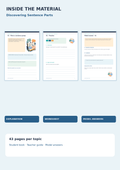
Discovering German Sentence Parts | Subject, Predicate, Accusative & Dative Objects | German Grammar Unit | Grades 8–12
Discovering German Sentence Parts | Subject, Predicate, Accusative & Dative Objects | German Grammar Unit | Grades 8–12
Discovering German Sentence Parts is a complete German grammar unit on sentence parts (Satzglieder): eight modules in a 27-page student book, plus a 16-page teacher edition with an eight-lesson sequence, model answers, assessment anchors, sources and an AI disclosure.
German word order stops being mysterious once students see sentences as groups rather than single words. They move a whole group to the front with the movement test (Tom baut im Garten eine Hütte becomes Eine Hütte baut Tom im Garten), find the predicate even when its parts are split, ask targeted questions to find the subject, the accusative and the dative object, sort out adverbials of time, place and manner, combine parts into longer sentences and finish as error detectives. Explanations are in English; every example sentence is German.
What's Included
- 27-page student book with eight modules
- Every module: explanation, worked example, guided practice and a transfer challenge
- A/B/C tasks: secure terms, apply and explain, transfer
- Sentence starters and partner talk for supported entry
- 16-page teacher edition: teaching rationale and an eight-lesson sequence with timings
- Model answer and assessment anchor (recall · apply · transfer) for every module
- Sources and AI disclosure
- Print-ready PDF (A4; prints on US Letter with fit-to-page)
Module Sequence
- Move a sentence group — the movement test
- The predicate — verb frames such as hat gebaut and werden laufen
- The subject — finding it with a question
- Accusative object — wen oder was?
- Dative object — wem?
- Adverbials — time, place and manner, as in Im Park spielt Lea heute fröhlich
- Combine sentence parts — building longer sentences
- Error detective — finding and correcting mistakes
Students Will Learn To
- identify sentence parts with the movement test and targeted questions
- distinguish subject, predicate, accusative object, dative object and adverbials
- use this knowledge to build and correct German sentences
Perfect For
- High school German I–III and AP German preparation (Grades 8–12)
- College-prep German grammar review
- German heritage-language programs
- Tutoring and independent study
- Homeschool world languages
Why Teachers Choose This Unit
- A complete sequence, not a set of loose worksheets
- Every task has a written model answer
- Differentiated so the whole class works on the same goal with different amounts of support
- Illustrations used as discussion prompts, with facts checked against the text or a real model
- Plan 8–12 lessons and teach straight from the PDF
Created with AI assistance: ChatGPT (OpenAI) and Claude (Anthropic). All materials were reviewed and edited by a qualified teacher before publication.
Frequently Asked Questions
What German level do students need?
Students should know basic present-tense sentences and the nominative, accusative and dative articles. It fits the end of German I and German II–III well.
Is the unit in German or English?
Explanations and instructions are in English; all example and practice sentences are German.
How long does it take?
Plan eight to twelve lessons, or use the eight modules as stations.
How is it delivered?
As an instant digital download after checkout. Nothing is shipped.
$24.99 – buy now
PDF · instant download
🔒 Secure checkout · ♾️ reuse every yearFAQ about this resource
More Grammar & Spelling resources for Cross-Grade Resources

Review: Discovering German Sentence Parts | Subject, Predicate, Accusative ...
Discovering German Sentence Parts | Subject, Predicate, Accusative & Dative O... is a fully worked-out teaching resource for Grammar & Spelling at Cross-Grade Resources level (Grades 8–12). Its strength is that it is finished: worksheets, answer keys and teacher notes are all there, so a lesson can start without extra prep.
Teachers covering a topic at short notice, early-career teachers under planning pressure, and anyone picking up a cover lesson — and any situation where a lesson has to be ready today.
An editorial assessment of structure, scope and classroom use. It is not a customer review.