

✓ Added to cart


Haunted House Math | Arrays, Fact Families & Multiplication | Grades 2–3
Haunted House Math | Arrays, Fact Families & Multiplication | Grades 2–3
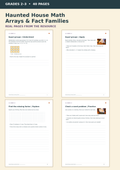
Haunted House Math is a Halloween arrays and fact-families unit for Grades 2–3: a 28-page student workbook and a 12-page teacher guide. Students use the windows of a friendly house as labeled arrays to connect equal groups, multiplication and division.
The workbook uses one convention throughout: the first factor counts the rows and the second counts the windows in each row. Students begin with 3 rows of 4 windows (4 + 4 + 4 = 12), then turn an array a quarter turn to see that 3 × 4 and 4 × 3 both make 12, and that switching the factors in 5 × 5 changes nothing. They find missing factors by listing every array of 12 windows, and they build the fact family for 2, 5 and 10. One question asks whether 2, 4 and 9 can make a fact family, and another asks them to correct 12 ÷ 4 = 8. Later they break 7 × 5 into 5 × 5 and 2 × 5, and check a window question that cannot be solved because information is missing. Each block has Understand, Practice, Explore and Apply pages.
What's Included
- 28-page student workbook with six four-page learning blocks, a learning check (p. 27) and a word bank (p. 28)
- 12-page teacher guide with answers, preparation notes and differentiation
- Mixed prompts: draw, build with counters, explain, correct a mistake
- Editable DOCX text version (pagination may differ)
- Print-ready A4 PDF that prints on US Letter with fit-to-page
Six Learning Blocks
- Equal groups — write addition and multiplication sentences for rows of windows, and see why 5 + 2 does not count five baskets of two keys.
- Turn an array — switch the factors in 3 × 4 or 2 × 6 and explain why the total stays the same.
- Find the missing factor — solve 3 × __ = 12 and list all arrays of 12; 18 lanterns in 3 equal rows gives 18 ÷ 3 = 6.
- A fact family — write four related facts for 2, 5 and 10, and tell sharing 20 cookies from packing them in bags.
- Break apart a larger array — use 5 × 4 + 2 × 4 for 7 × 4, and spot that 5 rows plus 4 rows is nine, not eight.
- Check a word problem — sketch, write a number sentence, and decide when a question has too little information.
Students Will Learn To
- Connect equal groups, addition and multiplication
- Read an array by rows and switch the factors
- Find a missing factor and use division to check multiplication
- Break apart a larger array to make an easier calculation
Perfect For
- Halloween week in Grades 2–3, or the fall-themed alternative The Mysterious Fall House
- Small-group math blocks and early finishers
- Sub plans: one block needs only the workbook pages, counters and the answer key
- Arrays practice before or after a multiplication unit
- UK and Australia: roughly maps to Year 3–4 (UK) and Year 3 (AU) multiplication and division
Why Teachers Choose This Unit
- The guide gives answers and error-diagnosis advice: counting, wrong operation and equal groups need different support
- The teacher guide gives SUPPORT, CORE and CHALLENGE guidance
- Only labeled window arrays are counting models; decorative illustrations are not, which keeps counting honest
- Students explain and correct, so the focus stays on thinking rather than speed
- Division is introduced through models, so students need only counting and grouping to start
Pair it with Haunted House Classroom Adventure and Haunted House for Sale! for a Halloween week across math and writing.
Created with AI assistance: ChatGPT (OpenAI). Illustrations were generated with OpenAI image generation as friendly discussion prompts; they are not photographs. Edited for classroom use before publication.
Frequently Asked Questions
Which grades and standards does this fit?
It is written for Grades 2–3. It sits closest to Common Core 2.OA.C.4 (arrays) and 3.OA (multiplication and division within 100, properties of operations). In the UK it roughly maps to Year 3–4 multiplication and division, and in Australia to Year 3 multiplication. No alignment or endorsement is claimed.
How long does it take?
There are six learning blocks of about 30–45 minutes each. Allow extra time when division is new. Each block opens with a shared example and modeling, then independent practice. The learning check on page 27 has no time pressure.
What materials do I need?
Pencils, two colors and 30–40 counters per pair. Students can also draw larger arrays. Students should already be able to count and group; division is introduced through models, so no earlier division work is needed.
Is it only for Halloween, and how is it delivered?
No. The Halloween theme is friendly and optional, and the unit can be called The Mysterious Fall House. The math is identical in either setting. You get an instant digital download with the PDF and an editable DOCX text version.
$12.99 – buy now
PDF · instant download
🔒 Secure checkout · ♾️ reuse every yearFAQ about this resource
More Math resources for Elementary School


Review: Haunted House Math | Arrays, Fact Families & Multiplication | Grade...
Haunted House Math | Arrays, Fact Families & Multiplication | Grades 2–3 is a fully worked-out teaching resource for Math at Elementary School level (Grades 2–3). Its strength is that it is finished: worksheets, answer keys and teacher notes are all there, so a lesson can start without extra prep.
Teachers covering a topic at short notice, early-career teachers under planning pressure, and anyone picking up a cover lesson — and any situation where a lesson has to be ready today.
An editorial assessment of structure, scope and classroom use. It is not a customer review.