✓ Added to cart

Meadows, Flowers & Pollination | Flower Parts, Pollinators, Food Chains & Biodiversity | Life Science Unit | Grades 5–6
Meadows, Flowers & Pollination | Flower Par...
$24.99
✓ Download link is ready the moment you check out.
🔒 Secure checkout · Instant download · Reusable classroom license
Meadows, Flowers & Pollination | Flower Parts...
$24.99
📄 PDF
Meadows, Flowers & Pollination | Flower Parts, Pollinators, Food Chains & Biodiversity | Life Science Unit | Grades 5–6
TeachLessons
🔬 Science
Meadows, Flowers & Pollination | Flower Parts, Pollinators, Fo...
Approx.: US Grades 5–6 · UK (England) Years 6–7 · AU Years 5–6 · CA Grades 5–6 · NZ Years 6–7. Regional entry ages and curricula vary, especially Québec and other UK nations. Worldwide use; 24/7 support for help and adaptation requests.
🖨️
Print
& digital
🎓
Grades 5–6
Grade level
⚡
Instant
Download
✅
Standards
Adaptable
Differentiated tasks for mixed-ability classes
Answer keys and teacher notes included
Print-ready and screen-friendly
Buy once, reuse every school year
Answer KeysEcosystemsGrades 5-6Life ScienceNo Prep
$24.99
Instant download
teachlessons.us
Meadows, Flowers & Pollination | Flower Parts, Pollinators, Food Chains & Biodiversity | Life Science Unit | Grades 5–6
🔬
Facts
🔬 Science 🎓 Cross-Grade Resources · Grades 5–6

Meadows, Flowers & Pollination | Flower Parts, Pollinators, Food Chains & Biodiversity | Life Science Unit | Grades 5–6

Approx.: US Grades 5–6 · UK (England) Years 6–7 · AU Years 5–6 · CA Grades 5–6 · NZ Years 6–7. Regional entry ages and curricula vary, especially Québec and other UK nations. Worldwide use; 24/7 support for help and adaptation requests.
⭐⭐⭐⭐⭐
Trusted by 10,000+ teachers in the US, UK and Australia · 4.9 / 5 · 98% would recommend
$24.99
One-time payment · no subscription · taxes calculated at checkout
⚡ Instant download 🖨️ Print-ready 🎯 Differentiated✅ Answer keys
📦 What you get
Ready-to-teach Science resource as a downloadable PDF
Differentiated student worksheets for mixed-ability classes
Answer keys and teacher guidance so you can mark in minutes
Sent to your inbox and stored in your account right after checkout
Buy once, use it with all your own classes, every year
🔒 Secure checkout
⚡ Instant download
🌍 US · UK · AU friendly
♾️ Reusable license
💳 Card🅿️ PayPal🍎 Apple Pay🔵 Shop Pay💳 G Pay
⚡
Instant download – your files arrive by email seconds after checkout
💾
Always available – re-download any time from your account
🌍
Works in US, UK and Australian classrooms – Approx.: US Grades 5–6 · UK (England) Years 6–7 · AU Years 5–6 · CA Grades 5–6 · NZ Years 6–7. Regional entry ages and curricula vary, especially Québec and other UK nations. Worldwide use; 24/7 support for help and adaptation requests.
Product description

Meadows, Flowers & Pollination | Flower Parts, Pollinators, Food Chains & Biodiversity | Life Science Unit | Grades 5–6

Meadows, Flowers & Pollination is a complete life science unit on meadow habitats, flower parts, pollinating insects, food webs and site management for grades 5–6: a 31-page student book and a 14-page teacher guide.

Students start with two areas: Area A is closely mown with 2 flower forms, Area B has tall vegetation with 6. They plan a fairer comparison and make an observation card with place, date, weather and uncertain identifications. Later they label a simple flower diagram, put pollen transfer, fertilization and seed formation in order, and explain why "The bumblebee wanted to help the plant" is imprecise. They draw grass → grasshopper → bird, join two chains into a food web and rethink a border that is mowed every week. The last module uses fictional counts (8 visits on Monday in sunshine, 3 on Tuesday in rain, 9 on Wednesday) to show why 20 visits are not 20 different animals.

What's Included

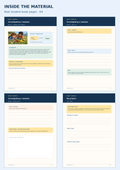
  • 31-page student book with a "Your learning journey" page for prior knowledge
  • Six four-page modules: learning text and example, Tasks 1 and 2 with a help box, an explain task with own application, and extra practice with reflection
  • "My project" (2 pages): plan a small meadow investigation with a defined area, an observation table, a pollination question and a justified management idea
  • "Learning check without the text" (2 pages) with one prompt per module
  • "My glossary and reflection" page
  • 14-page teacher guide: six-step lesson sequence, differentiation, preparation notes and project support
  • Six module answer pages, expected learning check responses and four 0–4 point criteria
  • Print-ready A4 PDF that prints on US Letter with fit-to-page

Six Modules

  1. Investigating a meadow — comparing a mown lawn with tall vegetation and planning a fair observation of a defined area.
  2. Flowers as plant organs — anther, stigma, petal and ovary, and the difference between pollination and fertilization.
  3. Insects transfer pollen — describing a bumblebee's three flower visits and naming the evidence a pollination claim needs.
  4. Feeding relationships — food chains, a food web and the "is eaten by" arrow direction.
  5. Management and biodiversity — balancing play space and insect needs on a school site with a measurable goal.
  6. Interpreting data cautiously — totaling visit counts, keeping visits apart from animals and observations apart from conclusions.

Students Will Learn To

  • Plan a fair meadow observation using the same area, time and method
  • Name the parts of a flower and explain pollination in one sentence, separate from fertilization and seed formation
  • Build food chains and a food web with arrows that point from food to consumer
  • Describe what they see before making a claim, and say what a small count can and cannot show

Perfect For

  • Grade 5–6 life science work on plants, pollinators and ecosystems
  • Classes with a schoolyard edge or school garden to observe
  • UK and Australian classrooms: roughly maps to Years 6–7 in England and Years 5–6 in Australia
  • School-grounds projects where students propose and check a change to mowing
  • Sub plans and homeschool: the printed examples carry each module, and every answer is in the teacher guide

Why Teachers Choose This Unit

  • Answer pages for Tasks 1–3, extra practice and further thinking in every module
  • Three paths in the teacher guide: support, core and extension
  • Four 0–4 point criteria: key concept, example and reasoning, application or product, and revision
  • Around 8–12 lessons, and each module can be used on its own
  • Clear limits: students never catch animals or use them as experimental subjects, and the AI illustrations are labeled as discussion prompts, not botanical references

Also part of the Nature & Science Bundle: three complete units for $39.90, or all ten units in the Complete Learning Books Bundle for $99.90.

Created with AI assistance: ChatGPT (OpenAI) and Claude (Anthropic). Illustrations were generated with OpenAI ImageGen as discussion prompts; they are not photographs or scale diagrams. Edited for classroom use before publication.

Frequently Asked Questions

Which grades and standards does this unit fit?

It is written for grades 5–6. The content sits closest to NGSS life science work on plants, pollination and food webs, and it roughly maps to Years 6–7 in England and Years 5–6 in Australia. No official endorsement is claimed.

How long does the unit take?

Plan around 8–12 lessons for the full unit. The meadow project may take longer if students observe outdoors. Each four-page module can also be taught on its own, for example Feeding relationships inside a food web sequence.

Do students have to go outside?

No. Every task works from the printed examples. If you add field work or the project, the teacher guide asks for a safe observation area, an identification guide and an optional magnifier. Students do not catch animals, animals are not used as experimental subjects, and school rules apply on the site.

How is it delivered?

As an instant digital download after purchase: the student book and teacher guide as print-ready PDF files. Nothing is shipped.


STEP 1
Download
Check out and your files land in your inbox and your account within seconds.
STEP 2
Print or project
Print the pages or share them on your screen — no formatting work needed.
STEP 3
Teach
Run the lesson as written and mark it with the answer keys. Reuse it next year.
⭐ Teacher trust
4.9
⭐⭐⭐⭐⭐
Trusted by 10,000+ teachers in the US, UK and Australia
4.9 / 5 · 98% would recommend TeachLessons resources
📋 Resource details
🔬
Subject: Science
🎓
Grade level: Cross-Grade Resources · Grades 5–6
🌍
Equivalents: Approx.: US Grades 5–6 · UK (England) Years 6–7 · AU Years 5–6 · CA Grades 5–6 · NZ Years 6–7. Regional entry ages and curricula vary, especially Québec and other UK nations. Worldwide use; 24/7 support for help and adaptation requests.
💾
Format: PDF (instant download)
🖨️
Use: Print, projector, tablet
✅
Standards: Adaptable to US state standards, the UK National Curriculum and the Australian Curriculum
🎯
Differentiation: Multiple levels included
📋
Answer keys: Included
♾️
License: Single teacher, unlimited own classes
🔄
Last reviewed: 2026
🔬
⭐ Browse
More Science resources
Ready-to-teach material for Cross-Grade Resources

$24.99 – buy now

PDF · instant download

🔒 Secure checkout · ♾️ reuse every year
Frequently asked questions

FAQ about this resource

Your download link is emailed to you the moment checkout completes, usually within seconds. The files also stay in your customer account under Orders, so you can download them again any time.
It is written for Cross-Grade Resources · Grades 5–6. International equivalents: Approx.: US Grades 5–6 · UK (England) Years 6–7 · AU Years 5–6 · CA Grades 5–6 · NZ Years 6–7. Regional entry ages and curricula vary, especially Québec and other UK nations..
The content is written to be curriculum-neutral, so it slots into US state standards, the UK National Curriculum and the Australian Curriculum. Objectives are stated in plain language so you can map them to your own scheme of work in a couple of minutes.
Yes. You get a single-teacher license covering all of your own classs, this year and every year after. Sharing the files with colleagues, uploading them to a public site or reselling them is not allowed — additional teacher licenses are available on request.
A print-ready PDF in US Letter and A4 friendly layout. Everything works on paper, on a projector and on tablets.
Yes — answer keys and teacher guidance come with the resource, so marking takes minutes rather than an evening.
Yes. Tasks come at several levels of challenge with scaffolds for students who need support and extensions for those who finish early.
Card, PayPal, Apple Pay, Google Pay and Shop Pay are all available. Prices are shown in your local currency where supported, and any tax or VAT is calculated at checkout. Purchase orders and school invoices are available on request.
The product images show real pages from the download, so you can judge the layout and depth before buying. Since the files are delivered instantly, digital purchases are not refundable — message us before ordering if anything is unclear and we will send you a sample page.
Editorial review

Review: Meadows, Flowers & Pollination | Flower Parts, Pollinators, Food Ch...

In short

Meadows, Flowers & Pollination | Flower Parts, Pollinators, Food Chains & Bio... is a fully worked-out teaching resource for Science at Cross-Grade Resources level (Grades 5–6). Its strength is that it is finished: worksheets, answer keys and teacher notes are all there, so a lesson can start without extra prep.

What stands out
Usable straight away — printing is the only prep
Answer keys and teacher notes are included in full
Several levels of challenge for a mixed-ability class
Worldwide use, with adaptation to your local curriculum
At a glance
Print-ready PDF
Download link right after checkout, stored in your account
One-time purchase, no subscription, reuse every year
Works in print, on a projector, whiteboard or tablet
Who it suits

Teachers covering a topic at short notice, early-career teachers under planning pressure, and anyone picking up a cover lesson — and any situation where a lesson has to be ready today.

Reviewed by: TeachLessons editorial team · Last reviewed: 2026
An editorial assessment of structure, scope and classroom use. It is not a customer review.