

✓ Added to cart


Multi-Digit Multiplication and Division | Area Model, Partial Products & Partial Quotients | Grade 4
Multi-Digit Multiplication and Division | Area Model, Partial Products & Partial Quotients | Grade 4
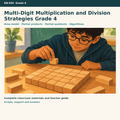
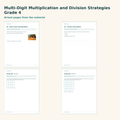
Multi-Digit Multiplication and Division Strategies is a math unit for Grade 4: a 36-page classroom material set and a 14-page teacher guide. Students multiply and divide with multi-digit numbers. They start with visual strategies and move step by step toward the standard algorithm. The goal is that students understand why a method works before they use it as a routine. The unit has ten lessons and three array labs.
Everything rests on place-value decomposition. A student who sees 23 as 20 and 3 can split 23 × 4 into two easier problems. The Area model shows that split as a rectangle, and the parts of the rectangle become Partial products that students add. Before calculating, students estimate, so they can check whether their answer makes sense. The Algorithm bridge links the partial products to the standard written method. Division follows the same path. Students first see division as grouping, then work with partial quotients and learn what to do with remainders. In Compare strategies they weigh different methods against each other, and Mixed application brings both operations together in word problems. Three array labs offer a closer look at 3 × 4, 4 × 6 and 5 × 5.
A learning routine page at the start shows students the steps they follow in each lesson, and a learning record at the end lets them note which strategies they can use with confidence. Multiplication comes first, then division uses the same place-value thinking. Students who need the visual models longer can keep using them while others move to the written method. The array labs give a quick review of the link between arrays and area.
What's Included
- Classroom Material: 36 pages (PDF)
- Teacher Guide: 14 pages (PDF)
- Editable DOCX text version of both files (pagination may differ)
- Editable PowerPoint presentation
- Print-ready A4 PDF that prints on US Letter with fit-to-page
The Ten Lessons
- Place-value decomposition: split numbers into tens and ones, hundreds and thousands
- Area model: show a product as a rectangle made of parts
- Partial products: multiply each part and add the results
- Estimate first: round to predict a reasonable answer
- Algorithm bridge: connect partial products to the standard method
- Division as grouping: see division as making equal groups
- Partial quotients: take away friendly multiples of the divisor
- Remainders: decide what a leftover means in context
- Compare strategies: weigh methods and choose one that fits
- Mixed application: use both operations in word problems
Students Will Learn To
- Break multi-digit numbers apart by place value
- Multiply using area models and partial products, then connect them to the algorithm
- Estimate before calculating and check whether answers are reasonable
- Divide using partial quotients and interpret remainders
- Compare strategies and choose one that fits the problem
Perfect For
- Fourth grade multiplication and division units
- Students who know their facts and are ready for larger numbers
- Small groups that need a visual route to the algorithm
- Review before Grade 5 work with larger divisors
- UK and Australia: roughly maps to Year 5
Why Teachers Choose This Unit
- Each lesson has a teacher guide page with answers and teaching decisions
- An assessment and algorithm expectations section clarifies what students should be able to show
- Notes on observation and responsive support help you decide who needs the visual models longer
- The sequence moves from understanding to written methods in clear steps
- Sources and production notes are listed at the end of the teacher guide
Created with AI assistance. Texts and illustrations were generated with AI support and edited for classroom use; sources and production notes are at the end of the teacher guide.
Frequently Asked Questions
Which grade level and standards does this unit fit?
It is written for Grade 4. The work sits closest to CCSS 4.NBT.B.5 (multi-digit multiplication), 4.NBT.B.6 (division with one-digit divisors) and 4.OA.A.3 (interpreting remainders). No alignment or endorsement is claimed.
Do students learn the standard algorithm?
Yes. Lesson 5, Algorithm bridge, connects partial products to the standard method. The teacher guide sets out algorithm expectations.
Is there an assessment?
Yes. The teacher guide includes an assessment and algorithm expectations section with answers.
Can I change the numbers in the problems?
Yes. The classroom material and teacher guide come as editable DOCX files. Use the PDF as the print reference.
$12.99 – buy now
PDF · instant download · 36 pages
🔒 Secure checkout · ♾️ reuse every yearFAQ about this resource
More Math resources for Elementary School
Review: Multi-Digit Multiplication and Division | Area Model, Partial Produ...
Multi-Digit Multiplication and Division | Area Model, Partial Products & Part... is a fully worked-out teaching resource for Math at Elementary School level (Grades 4). Its strength is that it is finished: worksheets, answer keys and teacher notes are all there, so a lesson can start without extra prep.
Teachers covering a topic at short notice, early-career teachers under planning pressure, and anyone picking up a cover lesson — and any situation where a lesson has to be ready today.
An editorial assessment of structure, scope and classroom use. It is not a customer review.