

✓ Added to cart
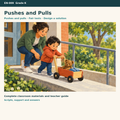


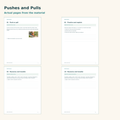

Pushes and Pulls | Forces, Fair Tests & a Design Challenge | Kindergarten
Physics Complete – Ready-to-Use Curriculu... · from $149.90 See bundle →
Pushes and Pulls | Forces, Fair Tests & a Design Challenge | Kindergarten
Pushes and Pulls is a science unit on forces and motion for Kindergarten: a 33-page classroom material set and a 14-page teacher guide. In ten lessons, students investigate what happens when they push or pull an object. The core idea is simple and easy for young students to grasp. A push or a pull can start something moving, stop it or change its direction.
The first four lessons cover exactly those cases. Students sort actions into push or pull. Then they start objects moving, stop them and change their direction. From Lesson 5 the focus shifts to strength. Students compare a gentle push with a stronger one and compare pulls with each other. With a ramp and different surfaces they run fair tests, changing only one thing while everything else stays the same. That is an early lesson in setting up a fair comparison. The last two lessons are a small engineering task. Students design a way to make a rolling object change direction. Then they improve their design based on what they saw. An opening page introduces the learning routine, and a learning record at the end shows what each student has done.
What's Included
- Classroom Material: 33 pages (PDF)
- Teacher Guide: 14 pages (PDF)
- 47 pages in total
- Editable DOCX text version (pagination may differ)
- Editable PowerPoint presentation (PPTX, editable text)
- Print-ready A4 PDF that prints on US Letter with fit-to-page
The 10 Lessons
- Push or pull. Sort actions as a push or a pull.
- Start moving. Use a push or pull to start an object moving.
- Stop moving. Use a push or pull to stop it.
- Change direction. Make a moving object go a new way.
- Gentle and stronger. Compare the effect of a gentle and a stronger push.
- Pull comparison. Compare pulls of different strength.
- Ramp release. Run a fair test with a ramp.
- Surface test. Compare how objects move on different surfaces.
- Design a turn. Plan a way to change a rolling object's direction.
- Improve the solution. Test and improve the design.
Students Will Learn To
- Tell whether an action is a push or a pull
- Use pushes and pulls to start, stop and turn objects
- Compare the effects of gentle and stronger pushes and pulls
- Run a simple fair test by changing only one thing
- Design, test and improve a way to change an object's direction
Perfect For
- Kindergarten physical science units
- Science stations with simple objects and ramps
- STEM time with a first design challenge
- Pre-K and Grade 1 classrooms looking for simple forces lessons
- Homeschool science with household objects
- UK and Australia: roughly maps to Reception and Year 1 in England and Foundation in Australia
Why Teachers Choose This Unit
- The teacher guide describes the NGSS boundaries, including what Kindergarten students are not expected to do.
- Notes on assessment are included with the NGSS section.
- Each lesson has its own answers and teaching decisions page.
- The guide sets out the teaching concept and planning for the unit.
- An observation and responsive support section helps you guide students during tests.
Created with AI assistance. Texts and illustrations were generated with AI support and edited for classroom use; sources and production notes are at the end of the teacher guide.
Frequently Asked Questions
What grade and standards does this fit?
It is written for Kindergarten. The unit sits closest to NGSS K-PS2-1 (compare the effects of different strengths or directions of pushes and pulls) and K-PS2-2 (analyze data to see if a design solution changes the speed or direction of an object), with the design lessons touching K-2-ETS1. The guide explains the boundaries of these expectations. No alignment or endorsement is claimed.
What materials do I need?
Everyday objects to push, pull and roll, something to build a ramp and a few different surfaces for the surface test. Check each lesson in the teacher guide before setup.
Do Kindergarten students really run fair tests?
Yes, in a simple form. In the ramp and surface lessons they change one thing and keep the rest the same. The guide notes where the NGSS boundaries lie, so you don't push beyond what the grade expects.
How do I know what students learned?
The teacher guide includes notes on assessment, answers for each lesson and an observation section. Students also fill in a learning record at the end.
$12.99 – buy now
PDF · instant download · 14 pages
🔒 Secure checkout · ♾️ reuse every yearFAQ about this resource
More Physics resources for School Resources

Review: Pushes and Pulls | Forces, Fair Tests & a Design Challenge | Kinder...
Pushes and Pulls | Forces, Fair Tests & a Design Challenge | Kindergarten is a fully worked-out teaching resource for Physics at School Resources level (Years 1). Its strength is that it is finished: worksheets, answer keys and teacher notes are all there, so a lesson can start without extra prep.
Teachers covering a topic at short notice, early-career teachers under planning pressure, and anyone picking up a cover lesson — and any situation where a lesson has to be ready today.
An editorial assessment of structure, scope and classroom use. It is not a customer review.