

✓ Added to cart


Simple Present: My Everyday Life | Routines, he/she/it Verb Endings, do/does Questions & Negatives, How Often | Grammar Unit | Grades 5–6
Simple Present: My Everyday Life | Routines, he/she/it Verb Endings, do/does Questions & Negatives, How Often | Grammar Unit | Grades 5–6
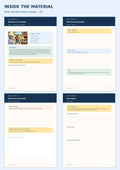
Simple Present: My Everyday Life is a complete grammar unit on the simple present tense for routines, verb endings, negatives, questions and frequency words for grades 5–6: a 31-page student book and a 14-page teacher guide.
Students work with short, everyday texts. Leo gets up at seven and plays football on Fridays, and students explain why that sentence is about more than one Friday. They complete "She … (read). He … (watch). It … (have) a tail," then fix "She studys and have a book." They make "Ben plays tennis" negative and correct "Ben doesn't plays tennis," turn a profile of Sam from York into do/does questions, and repair "She doesn't never walk to school." In the last module they correct every verb in Ella's draft ("Yes, she do") and write their own proofreading checklist.
What's Included
- Student book, 31 pages, opening with a "Your learning journey" page for prior knowledge
- Six four-page modules: learning text with a verb-form box, Tasks 1 and 2 with help, a Task 3 explain page with sketch space, and extra practice with reflection
- A two-page project: an illustrated routine profile of 70–90 words with he/she forms, a negative, a question with a short answer and two time or frequency phrases
- A two-page learning check without the text, one prompt per module
- A glossary and reflection page with one key term per module
- Teacher guide, 14 pages: lesson sequence, differentiation, six module answer pages, preparation notes, project support and assessment criteria
- Suggestions for partner interviews, verb cards and a weekly timetable
- Print-ready A4 PDF that prints on US Letter with fit-to-page
Six Modules
- Routines and habits — when we use the simple present, and how time phrases like "on Fridays" show a pattern
- He, she, it: verb endings — -s, -es and -ies endings, play/plays, and have/has
- Negatives with do and does — don't and doesn't with the base form, and why "doesn't plays" is wrong
- Questions with do and does — yes/no questions, question words first, and short answers like "Yes, she does"
- How often? — always, usually, often, sometimes, never, their position in the sentence, and "once a week"
- A clear routine text — topic sentence, time order, linking words and a proofreading checklist
Students Will Learn To
- Choose the right verb form for each subject, including spelling changes such as study/studies and watch/watches
- Form negatives and questions with do and does and keep the main verb in its base form
- Place frequency words correctly and tell the difference between "often" and "three times a week"
- Write and revise a short routine text that a partner can follow
Perfect For
- Grade 5 and 6 grammar lessons on verb agreement and the present tense
- ESL and ELL groups, including newcomers who need the do/does pattern made explicit
- UK and AU classrooms: roughly maps to Years 5–7 (upper KS2 in England) and Australian Curriculum v9 English, as well as EAL support
- Writing workshops where students proofread their own drafts for verb errors
- Sub plans and homeschool use, since each module works on its own
Why Teachers Choose This Unit
- Every task has a matching answer or clear criteria in the teacher guide
- Three paths for each module: support, core and extension
- Four assessment criteria scored 0–4: key concept, example and reasoning, application/product, revision
- 8–12 lessons in total, and modules can be taught separately
- Error-correction tasks are built from the mistakes students actually make, such as "Does Sam plays chess?" The illustrations are discussion prompts only
Also part of the Language & EAL Bundle: three complete units for $39.90, or all ten units in the Complete Learning Books Bundle for $99.90.
Created with AI assistance: ChatGPT (OpenAI) and Claude (Anthropic). Illustrations were generated with OpenAI ImageGen as discussion prompts; they are not photographs or scale diagrams. Edited for classroom use before publication.
Frequently Asked Questions
Which grades and standards does this unit fit?
It is written for grades 5–6 and works well for older ESL students too. It sits closest to the Common Core ELA language standards on grammar and usage. In England it roughly maps to upper KS2 English, and in Australia to Years 5–6 English and EAL/D support. No official endorsement is claimed.
How long does the unit take?
Plan for around 8–12 lessons. Each of the six modules fits one or two lessons, and the routine profile project and learning check take a few more. Modules can also be taught on their own, for example only the do/does question module.
Does it work for ESL and ELL students?
Yes. Each module repeats a small verb-form box (I play, she plays, Does she play? She doesn't play.) and keeps example texts short. The teacher guide suggests discussing the learning text orally, modeling examples and using verb cards, partner interviews and a weekly timetable. On the support path, Task 1 is discussed orally before students write.
How is it delivered?
It is an instant digital download: one PDF student book and one PDF teacher guide. Nothing is shipped.
$24.99 – buy now
PDF · instant download
🔒 Secure checkout · ♾️ reuse every yearFAQ about this resource
More Grammar & Spelling resources for Cross-Grade Resources


Review: Simple Present: My Everyday Life | Routines, he/she/it Verb Endings...
Simple Present: My Everyday Life | Routines, he/she/it Verb Endings, do/does ... is a fully worked-out teaching resource for Grammar & Spelling at Cross-Grade Resources level (Grades 5–6). Its strength is that it is finished: worksheets, answer keys and teacher notes are all there, so a lesson can start without extra prep.
Teachers covering a topic at short notice, early-career teachers under planning pressure, and anyone picking up a cover lesson — and any situation where a lesson has to be ready today.
An editorial assessment of structure, scope and classroom use. It is not a customer review.