

✓ Added to cart


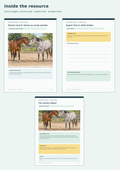
Understanding Horses: Jigsaw, Picture Cards & Escape Room | Horse Needs, Behavior & Animal Welfare | Life Science Unit | Grades 6–8
Understanding Horses: Jigsaw, Picture Cards & Escape Room | Horse Needs, Behavior & Animal Welfare | Life Science Unit | Grades 6–8
Understanding Horses is a cooperative life science unit on horse needs, behavior, and animal welfare for grades 6–8: a 36-page student book with foundation readings, picture cards, a jigsaw, and an escape room, plus a 12-page teacher guide with answers.
Students first read five foundation pages on horse needs and on separating observation ("The head is raised.") from inference ("Perhaps the horse heard something."). In the jigsaw, four expert groups each read two pages on one topic (social contact, movement and living space, food, water and rest, or body language and safety), fill in a note card, and teach their home groups. In the escape room, teams solve five stations, each with an optional hint card, to produce a five-digit code and record a reason for every digit. The core skill throughout is not over-reading a single image.
What's Included
- 36-page student book: five foundation readings, four picture cards (A–D), eight expert-text pages, four expert note cards, five escape-room stations, and five hint cards
- Foundation readings on horse needs, observing before inferring, living in a group, understanding care, and responsibility and safety
- Picture Cards A–D (social animals, movement and living space, food, water and rest, body language and safety), to print in color or project
- Jigsaw: four expert texts, each with a "think further" task, plus expert note cards for teaching the home group
- Escape room: five puzzle stations that produce a five-digit code, each with an optional hint card and space to record reasoning
- Research reflection page with a five-point checklist and a closing question
- 12-page teacher guide: four lesson blocks, answers for each expert group and station, and the solution code
- Print-ready PDF (A4; prints on US Letter with fit-to-page)
Learning Paths
- Foundations — Five readings on needs and careful looking
- Picture Cards A–D — Social contact, movement, food and water, body language
- Jigsaw: Expert Groups A–D — Read, note, then teach home groups
- Escape Room — Five stations, five-digit code, reasons recorded
- Transfer and Source Criticism — What a photograph can and cannot show
Students Will Learn To
- name the connected needs of horses and explain why one photograph cannot show long-term care
- separate observations from cautious inferences and word an inference tentatively
- work with a team to check claims against texts and images, and explain a safe choice around horses
Perfect For
- Grades 6–8 life science and animal welfare lessons, or cross-curricular work with ELA source evaluation
- Teachers who already use the Understanding Horses biology worksheets (grades 5–9): this is a separate unit with its own texts, jigsaw, and escape room, and it can follow or replace them
- UK and Australian classrooms: KS3 science (Years 7–8) on organisms and behavior, or Years 7–8 science with a source-evaluation focus
- Cooperative learning days, sub plans, and enrichment (teams of three or four; hint cards keep it open to mixed groups)
- Homeschool co-ops and groups of three or four; everything is done with the book, no animal contact required
Why Teachers Choose This Unit
- A complete teaching sequence: foundations, jigsaw, escape room, and transfer, in four lesson blocks
- Teacher answers for each expert group and each escape-room station, with the complete code and prompts to have teams explain each digit
- Written guidance for reading images: describe visible details, make only cautious inferences, and ask what information is missing
- Support and extension: sentence starters ("I see …", "I infer … because …") and optional hint cards, or testing a claim against the image and explaining the source's limits
- Illustrations are AI-generated example situations, not documentary photographs; the facts are in the texts, and the lesson stays in the classroom with respectful language about animals
Also part of the Science Bundle: four complete units for $49.90.
Created with AI assistance: ChatGPT (OpenAI) and Claude (Anthropic). Illustrations were generated with OpenAI ImageGen as discussion prompts; they are not photographs or scale diagrams. Edited for classroom use before publication.
Frequently Asked Questions
Which grade does this fit?
It is written for grades 6–8 and sits closest to middle school life science on organisms' needs and behavior, with work on arguing from evidence and judging sources. No official endorsement is claimed.
How long does it take?
It is organized in four lesson blocks. The jigsaw block is planned in 20, 10, 20, and 10 minutes (60 minutes in all). The escape room needs a little prep: five station sheets in envelopes, separate hint cards, and a code sheet. Blocks can be spread over several lessons.
Do students need horse experience, or a stable visit?
No. All tasks work in the classroom, and no direct contact with a horse is needed. The book says a separate stable visit would need permission, qualified supervision, and agreed rules. It also says students should not design feeding plans or judge a facility from a single image.
How is it delivered?
As an instant digital download after checkout. Nothing is shipped.
$29.99 – buy now
PDF · instant download
🔒 Secure checkout · ♾️ reuse every yearFAQ about this resource
More Science resources for Middle School


Review: Understanding Horses: Jigsaw, Picture Cards & Escape Room | Horse N...
Understanding Horses: Jigsaw, Picture Cards & Escape Room | Horse Needs, Beha... is a fully worked-out teaching resource for Science at Middle School level (Grades 6–8). Its strength is that it is finished: worksheets, answer keys and teacher notes are all there, so a lesson can start without extra prep.
Teachers covering a topic at short notice, early-career teachers under planning pressure, and anyone picking up a cover lesson — and any situation where a lesson has to be ready today.
An editorial assessment of structure, scope and classroom use. It is not a customer review.