

✓ Added to cart


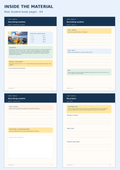
Observing & Understanding Weather | Temperature, Clouds, Wind, Rain & Forecasts | Science Unit | Grades 3–4
Observing & Understanding Weather | Temperature, Clouds, Wind, Rain & Forecasts | Science Unit | Grades 3–4
Observing & Understanding Weather is a complete science unit on describing, measuring and forecasting weather for grades 3–4: a 31-page student book and a 14-page teacher guide.
Students turn opinions into observations. Mia looks at the playground on Monday at 9 a.m. and says "Bad weather," and students rewrite that as a factual report: 12 °C, many clouds, dry ground, light wind. They read a temperature table from 8 °C at 8 a.m. to 15 °C at noon and plot it on a labeled graph. They work out that a ribbon blowing east means a westerly wind and add up a week of rain readings. The last module gives them a fictional forecast with "possible afternoon showers" and asks for a Plan A and a Plan B for a 9 a.m. to 1 p.m. outing.
What's Included
- Student book, 31 pages, opening with a "Your learning journey" page that collects what students already know
- Six four-page modules: learning text and example, Tasks 1 and 2 with help, a Task 3 explain page with sketch space, and extra practice with reflection
- A two-page project: students plan, then build a weather report from at least three comparable observations (or the labeled fictional data) with a table, a diagram and a cautious recommendation
- A two-page learning check without the text, one prompt per module
- A glossary and reflection page with one key term per module
- Teacher guide, 14 pages: lesson sequence, differentiation, six module answer pages, preparation notes, project support and assessment criteria
- Preparation notes for a thermometer, a sheltered measuring spot, an optional rain gauge and a wind ribbon
- Print-ready A4 PDF that prints on US Letter with fit-to-page
Six Modules
- Describing weather — temperature, precipitation, wind and cloud cover, and the difference between a judgment and a report
- Measuring temperature — reading a thermometer table, finding differences and planning a fair comparison of two school days
- Observing clouds — droplets and ice crystals versus invisible water vapor, plus a cloud diary with cautious predictions
- Investigating wind — naming wind by where it comes from, using a ribbon or windsock, and why one observation is not enough
- Measuring rain — rain gauges, millimeters, weekly totals and why a container under a roof gives a false reading
- Forecasts and decisions — what "showers possible" does and does not promise, and planning an outing around a forecast
Students Will Learn To
- Describe weather with measurable features, a place and a time instead of words like "lovely" or "bad"
- Record and compare temperature, wind and rain data collected with the same method and location
- Explain what clouds are made of and why a single cloud does not prove rain is coming
- Read a forecast carefully and justify a decision with a backup plan
Perfect For
- Grade 3 and 4 science units on weather and data collection
- Schoolyard observation weeks, with fictional data ready for days when observation time is short
- UK and AU classrooms: roughly maps to Years 3–5 (KS2 in England) and Australian Curriculum v9 science in Years 3–4
- Sub plans and homeschool use, since each module page set works on its own
Why Teachers Choose This Unit
- Every task has a matching answer or clear criteria in the teacher guide, including open tasks
- Three paths for each module: support, core and extension
- Four assessment criteria scored 0–4: key concept, example and reasoning, application/product, revision
- 8–12 lessons in total, and modules can be taught separately
- Safety notes are built in (never look at the sun, no storm experiments), and the illustrations are discussion prompts only
Also part of the Nature & Science Bundle: three complete units for $39.90, or all ten units in the Complete Learning Books Bundle for $99.90.
Created with AI assistance: ChatGPT (OpenAI) and Claude (Anthropic). Illustrations were generated with OpenAI ImageGen as discussion prompts; they are not photographs or scale diagrams. Edited for classroom use before publication.
Frequently Asked Questions
Which grades and standards does this unit fit?
It is written for grades 3–4 and sits closest to the NGSS weather and climate expectations for grade 3, with data work that also supports math. In England it roughly maps to KS2 science, and in Australia to Years 3–4 science. No official endorsement is claimed.
How long does the unit take?
Plan for around 8–12 lessons. Each of the six modules fits one or two lessons, and the project and learning check take a few more. Outdoor measuring over several days can stretch the timeline, and any module can be taught on its own.
What equipment do I need for the measuring tasks?
The teacher guide lists a suitable thermometer, a sheltered measuring spot, and optionally a rain gauge and a wind ribbon. If you cannot measure outside, every module includes fictional example data labeled as such, so students can complete all tasks from the book. Values are given in degrees Celsius and millimeters.
How is it delivered?
It is an instant digital download: one PDF student book and one PDF teacher guide. Nothing is shipped.
$24.99 – buy now
PDF · instant download
🔒 Secure checkout · ♾️ reuse every yearFAQ about this resource
More Science resources for Elementary School


Review: Observing & Understanding Weather | Temperature, Clouds, Wind, Rain...
Observing & Understanding Weather | Temperature, Clouds, Wind, Rain & Forecas... is a fully worked-out teaching resource for Science at Elementary School level (Grades 3–4). Its strength is that it is finished: worksheets, answer keys and teacher notes are all there, so a lesson can start without extra prep.
Teachers covering a topic at short notice, early-career teachers under planning pressure, and anyone picking up a cover lesson — and any situation where a lesson has to be ready today.
An editorial assessment of structure, scope and classroom use. It is not a customer review.