

✓ Added to cart


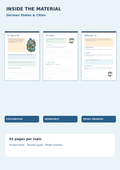
German States & Cities | The 16 Bundesländer, State Capitals & City-States | German Language & Culture Unit | Grades 6–10
German States & Cities | The 16 Bundesländer, State Capitals & City-States | German Language & Culture Unit | Grades 6–10
German States & Cities is a complete German language-and-culture unit on the geography of Germany: eight modules in a 27-page student book, plus a 16-page teacher edition with an eight-lesson sequence, model answers, assessment anchors, sources and an AI disclosure.
Germany has sixteen federal states, and students regularly mix up a state with a city. The unit starts with exactly that question, then works through the states and capitals in two rounds, the three city-states Berlin, Hamburg and Bremen that are both, and locating places on a labelled political map. It ends with a journey plan and a checked fact card that separates sourced facts from impressions. Instructions are in English, with German names used throughout, so the unit works in German I–III as the culture strand or in a world geography class.
What's Included
- 27-page student book with eight modules
- Every module: explanation, worked example, guided practice and a transfer challenge
- A/B/C tasks: secure terms, apply and explain, transfer
- Sentence starters and partner talk for supported entry
- 16-page teacher edition: teaching rationale and an eight-lesson sequence with timings
- Model answer and assessment anchor (recall · apply · transfer) for every module
- Sources and AI disclosure
- Print-ready PDF (A4; prints on US Letter with fit-to-page)
Module Sequence
- State or city? — two different categories
- The 16 states — locating every federal state on a political map
- Capitals I — state–capital pairs such as Bavaria–Munich and Hesse–Wiesbaden
- Capitals II — the remaining pairs, kept apart from other large cities
- City-states — why Berlin, Hamburg and Bremen are both city and state
- Where is it? — north, south, east and west with map evidence
- Plan a journey — a route across several states
- Create a fact card — state, capital, another city and a checked source
Students Will Learn To
- name Germany's 16 federal states and their capitals
- explain the difference between a state, a state capital and a city-state
- locate places with a labelled map and build a fact card from a checked source
Perfect For
- German I–III culture and Landeskunde lessons (Grades 6–10)
- World geography and Europe units
- German heritage and Saturday schools
- Exchange-trip preparation
- Homeschool world languages
Why Teachers Choose This Unit
- A complete sequence, not a set of loose worksheets
- Every task has a written model answer
- Differentiated so the whole class works on the same goal with different amounts of support
- Illustrations used as discussion prompts, with facts checked against the text or a real model
- Plan 8–12 lessons and teach straight from the PDF
Created with AI assistance: ChatGPT (OpenAI) and Claude (Anthropic). All materials were reviewed and edited by a qualified teacher before publication.
Frequently Asked Questions
Do students need to speak German?
No. Instructions and explanations are in English; German place names are used throughout. It works for beginners and fits the cultures strand of a German course.
Is it a map-coloring activity?
No. Students do use a labelled political map, but the modules focus on categories, reasoning and checking facts against a source, with A/B/C tasks at three levels.
How long does it take?
Plan eight to twelve lessons, or use the eight modules as stations.
How is it delivered?
As an instant digital download after checkout. Nothing is shipped.
$24.99 – buy now
PDF · instant download
🔒 Secure checkout · ♾️ reuse every yearFAQ about this resource
More German resources for Cross-Grade Resources


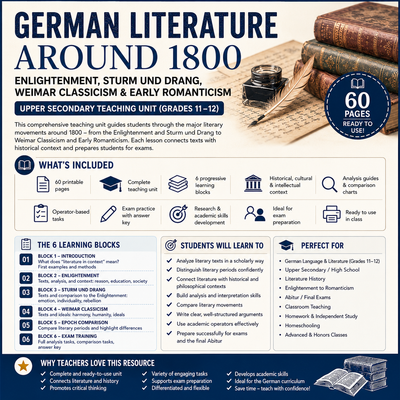
Review: German States & Cities | The 16 Bundesländer, State Capitals & City...
German States & Cities | The 16 Bundesländer, State Capitals & City-States | ... is a fully worked-out teaching resource for German at Cross-Grade Resources level (Grades 6–10). Its strength is that it is finished: worksheets, answer keys and teacher notes are all there, so a lesson can start without extra prep.
Teachers covering a topic at short notice, early-career teachers under planning pressure, and anyone picking up a cover lesson — and any situation where a lesson has to be ready today.
An editorial assessment of structure, scope and classroom use. It is not a customer review.