

✓ Added to cart
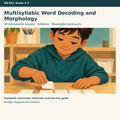

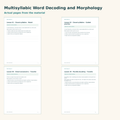

Multisyllabic Word Decoding and Morphology | 30 Intervention Lessons | Grades 3–5
Multisyllabic Word Decoding and Morphology | 30 Intervention Lessons | Grades 3–5
Multisyllabic Word Decoding and Morphology is a reading intervention for Grades 3–5: a 33-page classroom material set and a 34-page teacher guide. It is meant for students who read one-syllable words well but slow down or guess when a word gets long. Over 30 lessons, students learn to break long words into syllables and to spot the word parts that carry meaning. The teacher guide is almost as long as the student pages because every lesson has its own teaching key.
The lessons are arranged in ten sets of three. In each set, the first lesson is a model, where you show the pattern. The second is guided practice, and the third is transfer, where students apply the pattern to new words. The first six sets cover the six classic syllable types: closed syllables, open syllables, vowel-consonant-e, vowel teams, r-controlled vowels and consonant-le. Knowing these types helps students predict how a vowel will sound. Then the focus moves from sound to meaning. In the prefix and suffix sets, students find the parts added to the front and end of a word. Bases and families shows how many words grow from one base. The last set, Flexible decoding, brings it all together: students try different ways of splitting a word until it makes sense in context.
What's Included
- Classroom Material: 33 pages (PDF)
- Teacher Guide: 34 pages (PDF)
- Student pages for the model and transfer lessons, with practice pages that repeat the same format
- Editable DOCX text version of both files (pagination may differ)
- Editable PowerPoint presentation
- Print-ready A4 PDF that prints on US Letter with fit-to-page
The 30 Lessons
- Lessons 1–3: Closed syllables (model, practice, transfer)
- Lessons 4–6: Open syllables
- Lessons 7–9: Vowel-consonant-e
- Lessons 10–12: Vowel teams
- Lessons 13–15: R-controlled vowels
- Lessons 16–18: Consonant-le
- Lessons 19–21: Prefixes
- Lessons 22–24: Suffixes
- Lessons 25–27: Bases and families
- Lessons 28–30: Flexible decoding
Students Will Learn To
- Recognize the six syllable types and use them to predict vowel sounds
- Divide multisyllabic words into readable parts
- Identify common prefixes and suffixes and explain how they change a word
- Connect words that share a base
- Try more than one way to split an unfamiliar word and check it against meaning
Perfect For
- Tier 2 and Tier 3 reading intervention groups in Grades 3–5
- Reading specialists and interventionists who need a set sequence
- Upper elementary students who decode short words but stall on long ones
- Small-group word study inside a regular reading block
- UK and Australia: roughly maps to Year 4 through Year 6
Why Teachers Choose This Unit
- Every one of the 30 lessons has its own teaching key in the teacher guide
- The model, practice, transfer pattern repeats in each set, so students know what to expect
- A progress monitoring section helps you track growth over the sequence
- Notes on observation and responsive support help you decide when to reteach or move on
- Sources and production notes are listed at the end of the teacher guide
Created with AI assistance. Texts and illustrations were generated with AI support and edited for classroom use; sources and production notes are at the end of the teacher guide.
Frequently Asked Questions
Which grades and standards does this program fit?
It is written for Grades 3–5. The word work sits closest to CCSS RF.3.3, RF.4.3 and RF.5.3 (phonics and word analysis, including multisyllabic words and affixes). No alignment or endorsement is claimed.
Is this a dyslexia program?
No. It is a structured decoding and morphology sequence for students who need extra support with long words. It does not diagnose or treat dyslexia or any other learning difference.
Do I have to teach the lessons in order?
The sets build on each other, so the order is recommended. If a student already knows a syllable type well, you can use the transfer lesson as a quick check and decide from there.
How do I track progress?
The teacher guide includes a progress monitoring section and a teaching key for each lesson. Students also keep a learning record.
$17.99 – buy now
PDF · instant download
🔒 Secure checkout · ♾️ reuse every yearFAQ about this resource
More Reading & Phonics resources for Elementary School
Review: Multisyllabic Word Decoding and Morphology | 30 Intervention Lesson...
Multisyllabic Word Decoding and Morphology | 30 Intervention Lessons | Grades... is a fully worked-out teaching resource for Reading & Phonics at Elementary School level (Grades 3–5). Its strength is that it is finished: worksheets, answer keys and teacher notes are all there, so a lesson can start without extra prep.
Teachers covering a topic at short notice, early-career teachers under planning pressure, and anyone picking up a cover lesson — and any situation where a lesson has to be ready today.
An editorial assessment of structure, scope and classroom use. It is not a customer review.