

✓ Added to cart

Number Sense to 20 | 15 Hands-On Math Centers | Kindergarten
Number Sense to 20 | 15 Hands-On Math Centers | Kindergarten
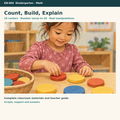
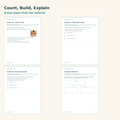
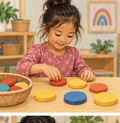
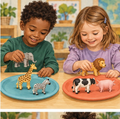
Number Sense to 20 is a set of math centers for Kindergarten: a 36-page classroom material set and a 21-page teacher guide. The 15 centers use real manipulatives such as counters or small objects. Each center has two pages. The first gives the task, and on the second students record what they built. Count, Build, Explain is the routine for the whole set.
The centers build from one-to-one matching up to acting out small story problems. Students start with One for each, matching objects one to one, and Quick look, where they recognize small structured groups. Five and ten serve as anchors. In Fill a ten-frame, students see that 7 is a full row of five and two more. Ten and some more and the Teen-number builder show 11 to 19 as a ten and some extra ones. Same number, new arrangement checks that the count stays the same when the objects move. Later centers cover counting on, comparing groups with more, fewer and equal, putting numbers in order and one more, one less. Ways to make five, Partners for ten and Split ten two ways prepare students for addition and subtraction. The last center, Story mat, has students act out addition and subtraction within 10. Reusable tools round out the set: a ten-frame mat for numbers up to 20, number cards 0–20, a number path and a two-part work mat.
What's Included
- Classroom Material: 36 pages (PDF)
- Teacher Guide: 21 pages (PDF)
- 57 pages in total
- Editable DOCX text version (pagination may differ)
- Editable PowerPoint presentation (PPTX, editable text)
- Print-ready A4 PDF that prints on US Letter with fit-to-page
The 15 Centers
- One for each. Match objects one to one.
- Quick look. Recognize small structured quantities.
- Fill a ten-frame. Use five and ten as anchors.
- Ten and some more. Represent teen numbers.
- Same number, new arrangement. Keep track of how many.
- Numeral match. Connect a numeral to its quantity.
- Count on. Start counting from a given number.
- More, fewer, equal. Compare groups within 10.
- Put numbers in order. Order quantities and numerals.
- One more, one less. Relate neighboring numbers.
- Ways to make five. Compose and decompose 5.
- Partners for ten. Find the partner that makes 10.
- Split ten two ways. Record different ways to break apart 10.
- Teen-number builder. Explain a ten and extra ones.
- Story mat. Act out addition and subtraction within 10.
Students Will Learn To
- Count objects one to one and tell how many
- Use five and ten as anchors on a ten-frame
- Show teen numbers as ten ones and some more ones
- Compare groups and order numbers to 20
- Break apart 5 and 10 in different ways and act out simple story problems
Perfect For
- Kindergarten math center rotations
- Small-group math with a teacher at one table
- Pre-K students ready for numbers past 10, and Grade 1 review
- Multilingual classrooms, since the hands-on tasks carry much of the meaning
- Homeschool math with household objects as counters
- UK and Australia: roughly maps to Reception and Year 1 in England and Foundation in Australia
Why Teachers Choose This Unit
- The guide explains the teaching design and how to run a center rotation.
- A standards page states which expectations the centers connect to and where that connection stops.
- Preparation notes include accessible participation, so every student can take part.
- Every center has its own answer and teaching notes page.
- An observation record helps you note what each student can do.
- An exit conversation and a family connection close the unit.
Created with AI assistance. Texts and illustrations were generated with AI support and edited for classroom use; sources and production notes are at the end of the teacher guide.
Frequently Asked Questions
What grade and standards does this fit?
It is written for Kindergarten. The set sits closest to Common Core K.CC (counting and cardinality), K.OA.A.3 and K.OA.A.4 (decomposing numbers and making 10), K.OA.A.1 and K.OA.A.2 (acting out addition and subtraction) and K.NBT.A.1 (teen numbers as ten ones and more ones). The guide explains the limits of these connections. No alignment or endorsement is claimed.
What materials do I need?
Counters or small classroom objects for building quantities. The printable tools are included: a ten-frame mat, number cards 0–20, a number path 0–20 and a two-part work mat. The guide has a preparation section to help you set up.
Can students work at the centers on their own?
Many students can once the routine is taught. The first pages introduce Count, Build, Explain and a center routine for using materials safely. The guide also covers how to rotate groups.
How do I keep track of what students know?
Each center has a recording page, and the teacher guide includes an observation record. An exit conversation at the end helps you hear how students explain their thinking.
$14.99 – buy now
PDF · instant download · 36 pages
🔒 Secure checkout · ♾️ reuse every yearFAQ about this resource
More Math resources for Teaching Resources

Review: Number Sense to 20 | 15 Hands-On Math Centers | Kindergarten
Number Sense to 20 | 15 Hands-On Math Centers | Kindergarten is a fully worked-out teaching resource for Math at Teaching Resources level (See description or ask support). Its strength is that it is finished: worksheets, answer keys and teacher notes are all there, so a lesson can start without extra prep.
Teachers covering a topic at short notice, early-career teachers under planning pressure, and anyone picking up a cover lesson — and any situation where a lesson has to be ready today.
An editorial assessment of structure, scope and classroom use. It is not a customer review.