

✓ Added to cart
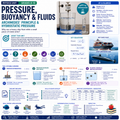


Pressure, Buoyancy & Fluids | Archimedes' Principle & Hydrostatic Pressure | Physics Unit | Grades 8–10
Physics Complete – Ready-to-Use Curriculu... · from $149.90 See bundle →
Pressure, Buoyancy & Fluids | Archimedes' Principle & Hydrostatic Pressure | Physics Unit | Grades 8–10
Pressure, Buoyancy & Fluids is a complete, no-prep physics unit for Grades 8–10: four double lessons (8 × 45 minutes) with teacher lesson plans, two reading passages, four print-ready worksheets, fully written answer keys, an assessment rubric and a 10-slide editable presentation — differentiated at three levels.
Guiding question: Why can a massive steel ship float while a small piece of metal sinks?
The unit links pressure, density, hydrostatic pressure and Archimedes' principle. Students use force measurements and displaced volume to explain floating through system-level reasoning rather than the material alone.
What's Included
- Teaching rationale and competency framework
- Complete lesson plans with timings for 4 double lessons (8 × 45 min)
- 2 detailed student reading passages
- 4 print-ready student worksheets
- Fully written solutions and an assessment rubric
- 20-point assessment with answer key
- 3 levels of differentiation: Foundation · Core · Extension
- Formula sheet and board summary
- 10 editable presentation slides (PPTX)
- Print and digital · US Letter and A4
The Four Double Lessons
- Pressure depends on force and area
- Fluid pressure increases with depth
- Buoyancy comes from a pressure difference
- Floating depends on the whole object
Topics Covered
- Pressure as force per unit area
- Density and its measurement
- Hydrostatic pressure and depth
- Archimedes' principle
- Upthrust and displaced volume
- Floating, sinking and average density
- Hydraulics and everyday applications
Students Will Learn To
- use central quantities, concepts and laws accurately in scientific language
- formulate a testable question, control variables, analyse measurements and identify uncertainty
- present graphs, equations, models and experimental reports appropriately for the audience
- test physical claims, identify model limits and weigh technological or societal applications
Prerequisites & Equipment
Prior knowledge: force and weight; area and volume; mass and density
Equipment for the investigation: spring balances, overflow can, measuring cylinders, assorted solids
Perfect For
- Middle School Physical Science
- High School Physics
- Honors and enrichment courses
- Homeschool and independent study
- Sub plans and review weeks
- Lab-based inquiry units
- NGSS-aligned science classrooms
Why Teachers Choose This Unit
- Genuinely no-prep: open, print, teach
- Answer keys for every task, not just the hard ones
- Three differentiation levels built into the same lesson
- Hands-on investigation with realistic sample data included
- Editable slides you can adapt to your own sequence
- Model limits made explicit — students learn where physics stops, too
Created with AI assistance: ChatGPT (OpenAI) and Claude (Anthropic). All materials were reviewed and edited by a qualified teacher before publication.
Frequently Asked Questions
What grade levels is this unit for?
It is written for Grades 8–10. The Foundation / Core / Extension tasks let you use the same lesson across a mixed-ability class.
How long does the unit take?
Four double lessons, 8 × 45 minutes in total. Each double lesson can be split into two single periods.
Do I need laboratory equipment?
The core investigation uses: spring balances, overflow can, measuring cylinders, assorted solids. Sample data and fully worked results are included, so the unit also works without equipment.
What file formats do I get?
Editable Word documents for the teaching unit and worksheets and an editable PowerPoint presentation, delivered as an instant digital download.
$24.99 – buy now
PDF · instant download
🔒 Secure checkout · ♾️ reuse every yearFAQ about this resource
More Physics resources for Cross-Grade Resources

Review: Pressure, Buoyancy & Fluids | Archimedes' Principle & Hydrostatic P...
Pressure, Buoyancy & Fluids | Archimedes' Principle & Hydrostatic Pressure | ... is a fully worked-out teaching resource for Physics at Cross-Grade Resources level (Grades 8–10). Its strength is that it is finished: worksheets, answer keys and teacher notes are all there, so a lesson can start without extra prep.
Teachers covering a topic at short notice, early-career teachers under planning pressure, and anyone picking up a cover lesson — and any situation where a lesson has to be ready today.
An editorial assessment of structure, scope and classroom use. It is not a customer review.