Easy Rhythm Activities for Kindergarten Music Class
Quick answer: Start kindergarten rhythm work with steady beat, then move to rhythm patterns. Easy activities include patting the beat to songs, clapping the rhythm of names, echo clapping, body percussion and reading simple rhythm cards with "ta" and "ti-ti." Five to ten minutes a few times a week is enough, and classroom teachers need no music training.
Start with steady beat
Beat is the steady pulse under the music, like a heartbeat. Kindergartners need lots of practice feeling it before they work on rhythm.
- Pat the beat: sit in a circle and pat knees to a nursery rhyme, such as "Hickory Dickory Dock." Then try shoulders, head or the floor.
- March the beat: march in a circle while you sing or play music. Change the speed and see if children can follow.
- Pass the beat: pass a beanbag around the circle, one pass on each beat. Start slowly.
- Beat keeper: one child taps a drum or claps the beat while the class sings. Rotate the job.
Watch for children who rush or drag. A slower tempo and a big, simple motion, like patting with both hands, helps most children lock in.
Then move to rhythm
Rhythm is the pattern of long and short sounds in the words or the music. A simple way to show the difference: half the class pats the steady beat while the other half claps the words of a rhyme. Children will hear that the claps and pats don't always match.
Use two rhythm syllables at first:
- Ta: one sound on a beat (a quarter note)
- Ti-ti: two quick sounds on one beat (two eighth notes)
Show them as pictures first, such as one big heart for ta and two small hearts for ti-ti, before you introduce note symbols.
Six easy rhythm activities for kindergarten
- Name rhythms: clap each child's name. "Sam" is one clap. "Ma-ri-a" is three quick claps. Let the class echo each name.
- Echo clapping: you clap a four-beat pattern, and the class echoes it. Keep patterns short and repeat favorites.
- Body percussion: build patterns with pat, clap, snap or stomp. For example: pat, pat, clap, rest.
- Food rhythms: "pie" is ta, "apple" is ti-ti. Put food picture cards in a row of four and read the pattern: pie, apple, pie, pie.
- Rhythm cards: show a card with four beats of ta and ti-ti. The class says the syllables, then claps them.
- Instrument patterns: children play a pattern on shakers, rhythm sticks or a drum. Pass instruments with a simple routine so the room stays calm.
A sample 10-minute rhythm routine
- Warm-up (2 minutes): pat the beat to a familiar song.
- Echo (2 minutes): four echo-clap patterns.
- New skill (3 minutes): read two rhythm cards or clap five names.
- Play (2 minutes): one child leads a pattern, the class echoes.
- Close (1 minute): end with a quiet pattern, such as tapping fingers on palms.
Repeat the same structure across the week and change only the content. Kindergartners settle into a routine they know.
Connect rhythm to literacy and math
- Syllables: clapping words and names supports phonological awareness, a key early reading skill.
- Counting: counting four beats and noticing which beats have two sounds builds early number sense.
- Patterns: repeating and extending rhythm patterns connects to pattern work in math.
You can use the same clapping routine during a phonics lesson. For example, clap the syllables in this week's words before reading them.
Keep it joyful and inclusive
- Short, playful and frequent works better than long and serious.
- Let children take turns leading patterns once they know the routine.
- Offer different ways to join in: clapping, tapping a drum, moving a scarf or pointing to cards.
- For children who find loud sounds hard, use soft patting or finger taps and keep instruments quiet.
- Praise steady effort, not perfect timing.
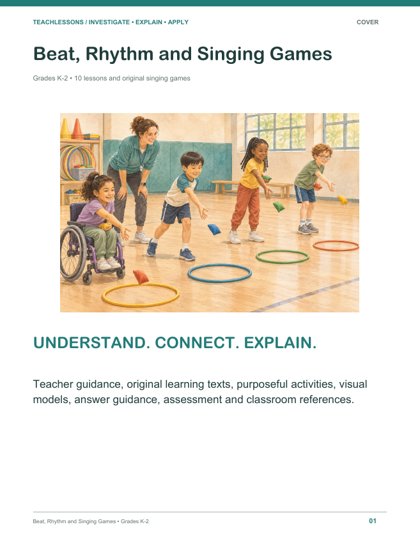
Beat, Rhythm and Singing Games is a ten-lesson K–2 music unit with original singing games, covering finding the beat, sound and silence, one and two sounds, echo and answer, composing four beats and more. Lessons run 25 to 35 minutes and are written for music specialists and classroom teachers. See also beat, rhythm and singing games that teach.
Every resource is built around the curriculum you teach – and if something doesn't fit your standards, the TeachLessons Guarantee applies: we adapt it for you.
Frequently asked questions
What is the difference between beat and rhythm?
Beat is the steady pulse that stays the same. Rhythm is the pattern of long and short sounds in the music or the words.
Do I need instruments to teach rhythm in kindergarten?
No. Clapping, patting, stomping and voices are enough. Shakers or rhythm sticks are a nice extra, not a requirement.
What do ta and ti-ti mean in music?
They are rhythm syllables. Ta stands for a quarter note, one sound on a beat. Ti-ti stands for two eighth notes, two quick sounds on one beat.
How often should kindergartners practice rhythm?
Five to ten minutes a few times a week works well. Short, frequent practice suits young children better than one long lesson.
Want a ready-to-teach Music?Complete, ready-to-use Music curriculum — lesson plans, activities & assessments all included.
Music Complete (Middle School) →Teaching High School Music?Complete, ready-to-use Music curriculum — lesson plans, activities & assessments all included.
Music Complete (High School) →FAQ about TeachLessons resources
The TeachLessons Music curriculum is available for Middle School and High School. Elementary teachers can also find cross-curricular and introductory music activities in our blog resources.
Music Complete includes lesson plans, listening activities, theory worksheets, performance rubrics, composition tasks, and ready-to-use assessments as print-ready PDFs.
No. Teacher notes, answer guides, and pacing suggestions support classroom teachers without specialist music training.
Yes. Complete Curriculum packages currently focus on Middle and High School, while our blog supports Elementary teachers with lesson ideas, classroom strategies, cross-curricular activities, free downloads, and Teach-Life-Balance support.
- Blog articles with practical lesson ideas
- Free resources via the newsletter
- Teach-Life-Balance for teachers at every level
The Teach-Life-Balance course is a time-saving programme for Elementary, Middle, and High School teachers. It helps with lesson planning, marking, admin, routines, boundaries, and workload management.
It includes a teacher planner, guides, templates, and practical strategies. Available at teachlessons.us/products/teach-life-balance.
After purchase you receive an instant email with your download link. Files are also stored in your customer account under Orders. Materials are print-ready PDFs for class, projection, or digital use.
Resources are licensed for personal classroom use. You may use them in your own classes. Sharing digital files or uploading them online is not permitted under a single-user licence. School licences are available on request.
Yes. Although primarily aligned to US standards, the lesson structures and subject content work well for UK and Australian classrooms with minor adaptation. The store supports GBP and AUD currency.
You might also like
Lesson ideas straight to your inbox.
Sign up and get a free starter resource pack plus weekly lesson ideas — no fluff, just things that work in real classrooms.
Almost there, !
Check your inbox and click the confirmation link to receive your free pack.
Comments
No comments yet — be the first to share your thoughts!
Leave a comment
Comments are reviewed before being published.
Thanks for your comment!
Your comment is being reviewed and will appear here shortly.