GCSE Art and Design: Artist Research and Annotation That Earns Marks

Artist research earns marks when each page does four things: shows a piece of the artist's work, analyses it using art vocabulary, links it to the student's own idea and shows an experiment inspired by it. Teach that four-part page and practise it with one artist at a time. The method supports the GCSE Art and Design plan.
Why copy-and-paste research fails
Many sketchbooks hold pages of biography copied from the internet, with a pasted image and little thought. Examiners and moderators look for evidence of understanding and a link to the student's own work. A name and date add little. A sentence about how a mark, material or composition choice affects the viewer shows something genuine.
Set a rule: no biography beyond three lines. Spend the rest of the page on looking, analysing and responding.
Show two example pages side by side, one with a pasted biography and one with a short analysis and a study. Ask the class which tells you more about the student. The contrast makes the point faster than any instruction, and students usually choose the second without prompting.
The four-part page
Give students a template with four boxes. The first holds a clear image of one artwork with title, date and medium. The second holds analysis: composition, colour, line, texture, scale. The third holds the link: how does this relate to my theme? The fourth holds a quick study or experiment in the style of the artist, done in the sketchbook.
Use the same template for each artist so that students can concentrate on the content. The Complete Art Education Bundle provides lessons, vocabulary and activity sheets across a range of artists, which helps if you want ready material for modelling the page.
Allow one lesson per artist for the page and one more for the practical response. Rushing the response is the most common weakness, and a full lesson of hands-on work gives the page the evidence of experiment that makes it convincing.
Annotation with a purpose
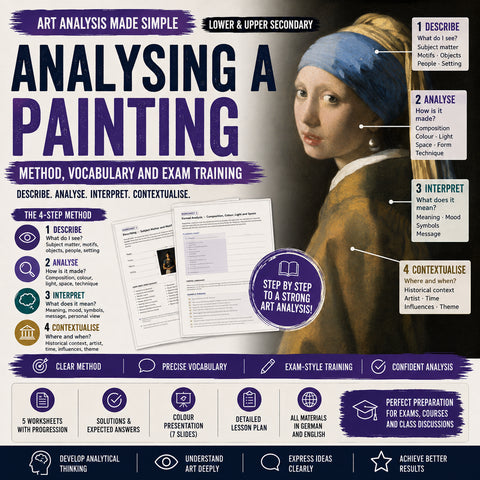
Annotations should explain choices, not describe the obvious. Teach a sentence frame: I chose this because, which shows, and it helps me to. Ask for at least three annotations per page, each using a different word from the art vocabulary list. The Analysing a Painting unit provides a method and a vocabulary bank that students can draw on directly.
- Say what you see: shape, line, colour, texture.
- Say what the artist did: how the material was handled.
- Say what effect results: mood, emphasis, meaning.
Practise annotation aloud before writing. Show an image, ask for three observations in thirty seconds, then turn each into a sentence with the frame. The speaking stage removes the fear of the blank page, and students who find writing hard often produce their best sentences this way.
Artists who connect to ideas
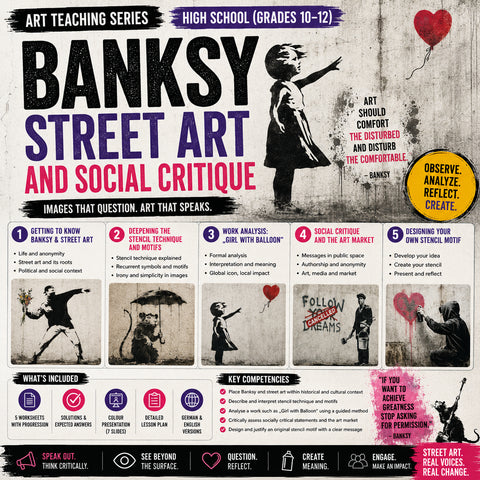
Choose artists whose concerns connect to students' themes. For work on social comment, street art and graphics offer clear links. The Banksy unit explores street art and social critique, and the article on teaching protest songs shows how to compare art and music as forms of protest.
For printmaking and social engagement, the Käthe Kollwitz unit shows how line and tone carry emotion. Students can try a quick charcoal or lino study after the lesson.
From research to own work
The key move is the link. Ask students to name one thing they will borrow from the artist and one thing they will change. Borrowing a technique and altering it is how artistic influence works, and it leads to work that is personal and not a copy. The article on quotation and sampling offers a useful frame for talking about borrowing and credit.
For three-dimensional work and personal themes, the Louise Bourgeois unit uses sculpture and memory as a starting point.
Saving your own time
Mark annotations by sampling. Read three pages per student across the term and give a short written next step. Use peer reading for the rest, with a checklist of the four parts. If planning keeps spilling over, the Teach-Life-Balance course offers templates that help.
Review the four-part pages at the end of each artist study, and ask students to choose their best for the final portfolio. Selecting forces reflection.
Every resource is built around the curriculum you teach – and if something doesn't fit your standards, the TeachLessons Guarantee applies: we adapt it for you.
Frequently asked questions
How many artists should a student research?
Enough to support the theme, usually two to four across the term. Depth matters more than number, so each study should include analysis and a practical response.
Should students write about the artist's life?
Only briefly, and only where it helps explain the work. Three lines of context is enough; the rest of the page should look at and respond to the art.
How do I help students write better annotations?
Use a sentence frame and a vocabulary list, and ask for three annotations per page. Model one aloud, thinking through why you chose the words.
Want a ready-to-teach curriculum?Complete, ready-to-use teaching curricula for Middle & High School — structured units, assessments, and more.
All Middle School Curricula →Teaching High School classes?Complete, ready-to-use teaching curricula for Middle & High School — structured units, assessments, and more.
All High School Curricula →FAQ about TeachLessons resources
TeachLessons provides K–12 resources. Complete Curriculum packages currently focus on Middle School and High School, while the blog also supports Elementary teachers.
Each package includes lesson plans, worksheets, assessments, rubrics, and teacher notes as print-ready PDFs.
Yes. Resources align with relevant US standards such as Common Core, NGSS, and the NCSS C3 Framework.
Yes. Complete Curriculum packages currently focus on Middle and High School, while our blog supports Elementary teachers with lesson ideas, classroom strategies, cross-curricular activities, free downloads, and Teach-Life-Balance support.
- Blog articles with practical lesson ideas
- Free resources via the newsletter
- Teach-Life-Balance for teachers at every level
The Teach-Life-Balance course is a time-saving programme for Elementary, Middle, and High School teachers. It helps with lesson planning, marking, admin, routines, boundaries, and workload management.
It includes a teacher planner, guides, templates, and practical strategies. Available at teachlessons.us/products/teach-life-balance.
After purchase you receive an instant email with your download link. Files are also stored in your customer account under Orders. Materials are print-ready PDFs for class, projection, or digital use.
Resources are licensed for personal classroom use. You may use them in your own classes. Sharing digital files or uploading them online is not permitted under a single-user licence. School licences are available on request.
Yes. Although primarily aligned to US standards, the lesson structures and subject content work well for UK and Australian classrooms with minor adaptation. The store supports GBP and AUD currency.
You might also like
Lesson ideas straight to your inbox.
Sign up and get a free starter resource pack plus weekly lesson ideas — no fluff, just things that work in real classrooms.
Almost there, !
Check your inbox and click the confirmation link to receive your free pack.

Comments
No comments yet — be the first to share your thoughts!
Leave a comment
Comments are reviewed before being published.
Thanks for your comment!
Your comment is being reviewed and will appear here shortly.