What Students Get Wrong in Medieval Daily Life Exam Questions (New York)
The four errors New York students repeat in written answers on medieval daily life, why each one forms, and the classroom modeling that removes it from their writing.
Medieval daily life reads as the easy unit and grades as the hard one. Students enjoy the material, write confidently, and lose credit in the same four places every year. Written responses on the Regents examinations reward a specific kind of writing that has little to do with how much a student knows about serfs. Here are the recurring errors in New York classrooms, and the modeling that removes each one.
Error one: describing the period instead of answering the question
A question asks about the effect of the manorial system on peasant families. The student writes about what peasants ate, wore and did. Everything in it is accurate and none of it answers the question asked. The student has stored the topic as a picture rather than a set of relationships, and under pressure the picture is what comes out.
The modeling that fixes it. Put a strong-looking but non-answering paragraph on the board and ask the class to underline every sentence that addresses the actual question. Usually one. Then rewrite it together, each sentence forced to begin with a phrase pointing back at the question stem. Do this three times across a unit and the habit transfers.
Error two: no sense of who is being talked about
Students write people in the Middle Ages and mean, without noticing, a male English peasant in about 1300. Daily life was not one life. Answers that do not distinguish between a town merchant, a rural laborer, a noblewoman and a monk cannot say anything precise, and precision is what earns credit.
The modeling that fixes it. Build a four-column chart at the start of the unit and keep returning to it. Every new piece of content goes in a column. Then require one qualifier in every claim: for rural households, in towns with a charter, for women in religious orders. Once students hear how much stronger that sounds aloud, they stop resisting. Content organized this way is easier to teach from, and the XXL Medieval History Bundle – Black Death, Feudalism & Society separates feudal structure, society and the Black Death into distinct strands, which makes the column chart something students build from the material rather than something you impose on it.
Error three: change and continuity collapsed into a story
Asked what changed in daily life across the period, students produce a chronology: things happened, then other things happened. The framework's attention to enduring issues expects an argument about what shifted, what held steady, and at what pace. A narrative is not that.
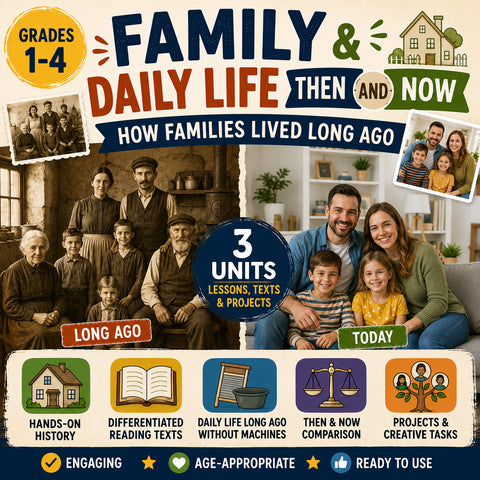
The modeling that fixes it. Give students two dates and one aspect of life, and require exactly three sentences: one on what is different, one on what is recognizably the same, and one on which of those matters more. The constraint does the teaching. Comparative material built around then-and-now thinking helps students rehearse the move on familiar ground first, and Family & Daily Life Then and Now Unit – Worksheets, Projects & Slides (Grades 1–4) is a fast way to run that rehearsal with a low reading load before applying it to medieval sources.
Error four: sources used as decoration
A student quotes a manorial record, then writes a paragraph that would be identical without it. The source sits in the answer like a stamp. Credit comes from what the student does with it: what it shows, what its origin makes it good for, and what it cannot tell you.
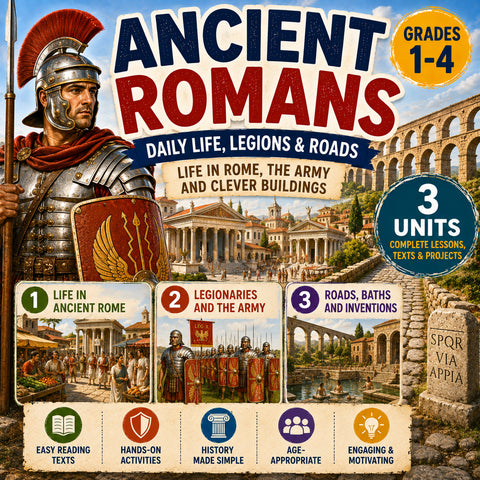
The modeling that fixes it. Ban the word shows for two weeks. Students must write this record was kept in order to ___, so it is reliable about ___ and silent about ___. It feels mechanical for four attempts, then students produce the reasoning without the stem. Comparing across periods sharpens it, since a Roman and a medieval household record raise different questions about who was recording, and The Ancient Romans: Daily Life, Legions & Roads Unit – Worksheets, Projects & Slides (Grades 1–4) supplies a contrasting set of everyday-life material for that comparison.
Building the modeling into normal lessons
None of this needs a separate exam-skills lesson, and those rarely work anyway. Attach one move to each lesson: the underline activity on Monday, the qualifier in Wednesday's writing, the three-sentence constraint on Friday. Ten minutes each, inside content you were teaching anyway.
Keep the examples you write with the class in a folder. Jointly rewritten paragraphs beat any published exemplar, because students remember producing them and will argue about them. When it is working, you can tell from the first line of a response: the student names who they are talking about and points at the question, and the rest of the answer follows from there.
Related reading from the Teacher Hub
Want a ready-to-teach History?A full World History curriculum with structured units, primary sources & assessments.
World History Complete (Middle School) →Teaching High School History?A full World History curriculum with structured units, primary sources & assessments.
All High School Curricula →FAQ about TeachLessons resources
World History Complete covers major civilizations, turning points, and thematic history concepts through inquiry-based units and source work.
It includes lesson plans, source documents, reading guides, map activities, DBQ scaffolds, discussions, and assessments.
Yes. It aligns with the NCSS C3 Framework and supports inquiry, source analysis, and evidence-based writing.
Yes. Complete Curriculum packages currently focus on Middle and High School, while our blog supports Elementary teachers with lesson ideas, classroom strategies, cross-curricular activities, free downloads, and Teach-Life-Balance support.
- Blog articles with practical lesson ideas
- Free resources via the newsletter
- Teach-Life-Balance for teachers at every level
The Teach-Life-Balance course is a time-saving programme for Elementary, Middle, and High School teachers. It helps with lesson planning, marking, admin, routines, boundaries, and workload management.
It includes a teacher planner, guides, templates, and practical strategies. Available at teachlessons.us/products/teach-life-balance.
After purchase you receive an instant email with your download link. Files are also stored in your customer account under Orders. Materials are print-ready PDFs for class, projection, or digital use.
Resources are licensed for personal classroom use. You may use them in your own classes. Sharing digital files or uploading them online is not permitted under a single-user licence. School licences are available on request.
Yes. Although primarily aligned to US standards, the lesson structures and subject content work well for UK and Australian classrooms with minor adaptation. The store supports GBP and AUD currency.
You might also like
Lesson ideas straight to your inbox.
Sign up and get a free starter resource pack plus weekly lesson ideas — no fluff, just things that work in real classrooms.
Almost there, !
Check your inbox and click the confirmation link to receive your free pack.

Comments
No comments yet — be the first to share your thoughts!
Leave a comment
Comments are reviewed before being published.
Thanks for your comment!
Your comment is being reviewed and will appear here shortly.