

✓ Added to cart


Budget on Irregular Income | Financial Literacy Unit | Grades 9–12
Digital download · nothing is shipped
- Instant download: the download link appears right after checkout and is also emailed to you.
- Format: PDF + slides, ready to print or project.
- TeachLessons Guarantee: if it does not fit your standards or pacing, email us within 30 days of purchase and we adapt it at no extra cost. How the guarantee works
Budget on Irregular Income | Financial Literacy Unit | Grades 9–12
Budget on Irregular Income shows grades 9–12 students why an average income can hide a month when money runs out. Using a running balance, students track a cash reserve through uneven months and find a change that keeps a safety floor.
What students work on
- Four months of income at $650, $380, $720 and $450 against $500 of essential costs each month, starting with no reserve.
- Month 3 income dropping to $510 and the new ending reserve.
- Income of $480, $620 and $400 with $500 costs and a $40 starting reserve.
- The starting reserve needed to keep at least $50 throughout.
- A $65 bill arriving in month 2 of the original profile.
Lesson sequence (4 × 90 minutes)
- From first reading to a model. Students build a running balance, find the tightest month and suggest a change that keeps a $60 floor.
- A revised case and a new context. Lower income in one month and a new profile test whether the running balance is set up correctly.
- Testing evidence and transferring a method. Students work backward to the starting reserve they need and add an unexpected bill.
- Learning check and feedback. The learning check asks which surplus covers the month 2 shortfall, followed by scored feedback and revision.
What's included
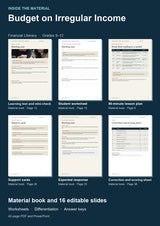
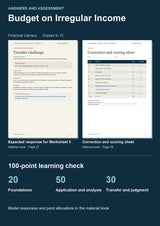
- Teaching Unit PDF – 42 pages: four 90-minute double lessons, an entry diagnosis, differentiation notes, teacher background, five learner inputs with mini-checks, five ready-to-copy worksheets with answer keys, support and extension cards, a 20-point independent learning check with model responses and a 100-point scoring sheet, plus peer review and revision pages
- 16 classroom slides (PPTX) with teacher notes
- Answer keys and model responses for every worksheet and the learning check
- Support and extension cards for differentiation
- A4 format that prints on US Letter with "fit to page"
- Digital download – no physical item is shipped
Who it's for
- US grades 9–12
- UK Years 10–13
- Australia Years 9–12
- Personal finance, economics and consumer math classes
- Homeschool families teaching money skills
- Advisory or life-skills blocks where students need practical money practice
Before you start
Students should add and subtract in a running total and read a table across months. It helps to discuss briefly which jobs have uneven pay.
Every resource is built around the curriculum you teach – and if something doesn't fit your standards, the TeachLessons Guarantee applies: we adapt it for you.
Created with AI assistance. Texts and illustrations were developed with ChatGPT (OpenAI) and Claude (Anthropic) and edited for classroom use.
Frequently Asked Questions
Which grades is Budget on Irregular Income for?
It is written for US grades 9–12, which matches UK Years 10–13 and Australian Years 9–12. Support and extension cards let you adjust the level within that range.
What's included and how long does it take?
You get a 42-page Teaching Unit PDF and 16 classroom slides with teacher notes. The plan covers four 90-minute double lessons, about six hours of class time, and splits easily into eight shorter periods.
Who is this unit a good fit for?
Students who already earn uneven income from part-time or gig work, and any class where you want budgeting to go beyond a single fixed monthly paycheck.
$24.99 – buy now
PDF · instant download
🔒 Secure checkout · ♾️ reuse every yearFAQ about this resource
More Financial Literacy resources for High School


Our summary: Budget on Irregular Income | Financial Literacy Unit | Grades 9–12
Budget on Irregular Income | Financial Literacy Unit | Grades 9–12 is a fully worked-out teaching resource for Financial Literacy at High School level (Grades 9–12). Its strength is that it is finished: worksheets, answer keys and teacher notes are all there, so a lesson can start without extra prep.
Teachers covering a topic at short notice, early-career teachers under planning pressure, and anyone picking up a cover lesson — and any situation where a lesson has to be ready today.
An editorial assessment of structure, scope and classroom use. It is not a customer review.