

✓ Added to cart
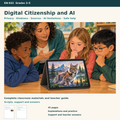


Digital Citizenship and AI | 8 Lessons, Privacy & Source Checks | Grades 3–5
Digital Citizenship and AI | 8 Lessons, Privacy & Source Checks | Grades 3–5
Digital Citizenship and AI is a grades 3–5 unit with 32 pages of classroom material and a separate 13-page teacher guide. It covers privacy, kindness, sources, the limits of AI and how to get safe help, across eight lessons. It is written for elementary teachers, technology and library staff and homeschool families who want a factual, age-appropriate introduction to online behavior and AI tools, with explanations, worked examples and application cases.
The unit has eight lessons, and each one uses the same three pages: an explanation page, a practice page with explanation, and a case card where students apply the idea to a situation. It begins with purpose and audience, then moves through private information, access and passwords, and kindness and harm. The middle lessons turn to AI: what AI generates, how images work as evidence, and how to check a claim. The last lesson asks students to use tools responsibly. Two vocabulary pages, a learning check, a short project with a record page and a reflection page complete the unit.
What's Included
- Classroom Material: 32 pages (PDF, print edition)
- Teacher Guide: 13 pages (PDF) with answers, case guidance and assessment feedback
- Editable DOCX text editions of the classroom material and the teacher guide
- Presentation with 17 slides (PPTX)
- Original illustrations; the PDF is the print reference and DOCX line breaks may differ
The 8 Lessons
- Lesson 1: Purpose and audience – Students ask who a message is for and why it was made.
- Lesson 2: Private information – Learners sort what is private from what is safe to share.
- Lesson 3: Access and passwords – Students practice thinking about who should have access to an account.
- Lesson 4: Kindness and harm – Learners look at how online words and actions affect other people.
- Lesson 5: What AI generates – Students learn what AI tools produce and where those tools fall short.
- Lesson 6: Images and evidence – Learners ask what an image can and cannot show as evidence.
- Lesson 7: Check a claim – Students practice checking a claim before they believe or share it.
- Lesson 8: Use tools responsibly – Learners decide how to use digital and AI tools with care.
Students Will Learn To
- Explain the purpose and audience of a message
- Tell private information from information that is safe to share
- Describe how kindness and harm show up online
- Explain what AI tools generate and name their limits
- Check a claim and use tools responsibly, including asking for safe help
Perfect For
- Grade 3–5 classroom teachers who need a unit on online behavior and AI basics
- Technology teachers and school librarians teaching digital literacy
- Counselors and homeroom teachers running lessons on kindness and privacy
- Homeschool families looking for printable lessons with a separate answer guide
- UK and Australia: roughly Years 4 to 6
Why Teachers Choose This Unit
- Every lesson follows the same explanation, practice and case card pattern, so students know what to expect
- AI is treated as a topic to understand and question, with its limits named in the lessons
- Privacy, passwords, kindness and source checks are covered in one short unit
- The teacher guide includes expected responses, an assessment key with feedback and a differentiation and observation chapter
- The editable DOCX text editions let you adjust wording for your class
Every resource is built around the curriculum you teach – and if something doesn't fit your standards, the TeachLessons Guarantee applies: we adapt it for you.
Created with AI assistance. Texts and illustrations were generated with AI support and edited for classroom use; sources and production notes are at the end of the teacher guide.
Frequently Asked Questions
Which standards does this fit?
The material does not name a single standards framework. It is closest to elementary digital literacy and citizenship goals, and no alignment or endorsement is claimed.
Are answers included?
Yes. The separate 13-page teacher guide has expected responses and teaching notes for all eight lessons, an assessment key with feedback, and a chapter on differentiation and observation.
How long does the unit take?
The material does not state a duration. Plan by lesson: each has three pages, and you can use all eight lessons in order or choose only some.
Do students need to use AI tools to complete the unit?
The material is printable classroom pages with explanations, practice and case cards. The teacher guide describes the lesson use, and the unit is about understanding AI, so it does not depend on students using an AI product.
$19.99 – buy now
PDF · instant download · 32 pages
🔒 Secure checkout · ♾️ reuse every yearFAQ about this resource
More Media & Digital Literacy resources for Elementary School
Review: Digital Citizenship and AI | 8 Lessons, Privacy & Source Checks | G...
Digital Citizenship and AI | 8 Lessons, Privacy & Source Checks | Grades 3–5 is a fully worked-out teaching resource for Media & Digital Literacy at Elementary School level (Grades 3–5). Its strength is that it is finished: worksheets, answer keys and teacher notes are all there, so a lesson can start without extra prep.
Teachers covering a topic at short notice, early-career teachers under planning pressure, and anyone picking up a cover lesson — and any situation where a lesson has to be ready today.
An editorial assessment of structure, scope and classroom use. It is not a customer review.