

✓ Added to cart
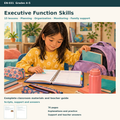


Executive Function Skills | 15 Lessons, Planners & Strategy Log | Grades 4–5
Executive Function Skills | 15 Lessons, Planners & Strategy Log | Grades 4–5
Executive Function Skills is a grades 4–5 unit with 56 pages of classroom material and a separate 20-page teacher guide. It covers planning, organization, monitoring and family support through 15 lessons, from naming the real task to transferring a strategy to a new task. It is written for upper elementary teachers, learning-support staff and homeschool families who want students to practice work habits in a structured way, with explanations, worked examples and application cases.
The unit has 15 lessons, and each one uses the same three pages: an explanation page, a practice page with explanation, and a case card where students apply the strategy to a situation. The sequence moves from understanding a task and breaking it into steps, through time estimates, visual plans, materials and starting cues, to focus, asking precise questions, pauses and monitoring. The final lessons cover revising a plan, finishing and submitting work, reviewing what helped and transferring a strategy to a new task. A task planner, a weekly organizer and a strategy log give students tools to keep using, and the unit closes with two vocabulary pages, a learning check, a project and a reflection page.
What's Included
- Classroom Material: 56 pages (PDF, print edition)
- Teacher Guide: 20 pages (PDF) with answers, case guidance and assessment feedback
- Task planner, weekly organizer and strategy log pages for students
- Editable DOCX text editions of the classroom material and the teacher guide
- Presentation with 17 slides (PPTX)
- Original illustrations; the PDF is the print reference and DOCX line breaks may differ
The 15 Lessons
- Lesson 1: Name the real task – Students state what a task actually asks before they start.
- Lesson 2: Break a task into steps – A larger task is split into steps that can be done one at a time.
- Lesson 3: Estimate time – Students predict how long work will take and compare it with real time.
- Lesson 4: Use a visual plan – A plan is drawn or laid out so the order of work stays visible.
- Lesson 5: Prepare materials – Students gather what they need before beginning.
- Lesson 6: Begin with a cue – A cue helps students start work instead of delaying.
- Lesson 7: Hold instructions outside memory – Instructions are written or posted rather than held in the head.
- Lesson 8: Focus and distraction – Students notice distractions and choose a response.
- Lesson 9: Ask a precise question – Learners practice asking for the specific help they need.
- Lesson 10: Plan a pause – A short pause is planned into the work period.
- Lesson 11: Monitor during work – Students check progress while the work is under way.
- Lesson 12: Revise a plan – A plan is changed when the first version does not work.
- Lesson 13: Finish and submit – Students check that work is complete and hand it in.
- Lesson 14: Review what helped – Learners look back at which strategies made a difference.
- Lesson 15: Transfer to a new task – A strategy is applied to a task the students have not seen before.
Students Will Learn To
- Name what a task asks and break it into ordered steps
- Estimate time and make a visual plan for their work
- Prepare materials and start work with a cue
- Monitor their progress, ask precise questions and revise a plan
- Review which strategies helped and use them on a new task
Perfect For
- Grade 4–5 teachers who want a closed unit on planning and organization
- Learning-support teachers and counselors who run small groups on study habits
- Teachers who want strategy practice with a separate answer and guidance document
- Homeschool families looking for printable lessons with a teacher guide
- UK and Australia: roughly Years 5 and 6
Why Teachers Choose This Unit
- Every lesson follows the same explanation, practice and case card pattern, so students know what to expect
- Task planner, weekly organizer and strategy log pages can be reused beyond the unit
- The teacher guide includes expected responses, lesson guidance, an assessment key with feedback and a differentiation and observation chapter
- Family support is part of the unit's focus alongside planning, organization and monitoring
- The editable DOCX text editions let you adjust wording for your class
Every resource is built around the curriculum you teach – and if something doesn't fit your standards, the TeachLessons Guarantee applies: we adapt it for you.
Created with AI assistance. Texts and illustrations were generated with AI support and edited for classroom use; sources and production notes are at the end of the teacher guide.
Frequently Asked Questions
Which standards does this fit?
The material does not name a single standards framework. It is closest to social-emotional learning and study-skills goals rather than a specific content standard, and no alignment or endorsement is claimed.
Are answers included?
Yes. The separate 20-page teacher guide has expected responses and teaching notes for all 15 lessons, an assessment key with feedback, and a chapter on differentiation and observation.
How long does the unit take?
The material does not state a duration. Plan by lesson: each has three pages, and you can use all 15 lessons in order or choose only some.
Is this a diagnostic or therapy program?
No. It is classroom teaching material on work habits, not an assessment, certified course or clinical program. Local adaptation and professional judgment remain necessary.
$29.99 – buy now
PDF · instant download · 20 pages
🔒 Secure checkout · ♾️ reuse every yearFAQ about this resource
More Life & Career Skills resources for Elementary School
Review: Executive Function Skills | 15 Lessons, Planners & Strategy Log | G...
Executive Function Skills | 15 Lessons, Planners & Strategy Log | Grades 4–5 is a fully worked-out teaching resource for Life & Career Skills at Elementary School level (Grades 4–5). Its strength is that it is finished: worksheets, answer keys and teacher notes are all there, so a lesson can start without extra prep.
Teachers covering a topic at short notice, early-career teachers under planning pressure, and anyone picking up a cover lesson — and any situation where a lesson has to be ready today.
An editorial assessment of structure, scope and classroom use. It is not a customer review.