

✓ Added to cart
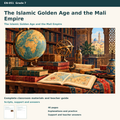

The Islamic Golden Age and the Mali Empire | 8 Lessons, 8 Case Cards & a Project | Grade 7
The Islamic Golden Age and the Mali Empire | 8 Lessons, 8 Case Cards & a Project | Grade 7
The Islamic Golden Age and the Mali Empire is a printable world history unit for Grade 7. Students study how regions were connected through trade and knowledge, how scholars translated and passed on texts, and how Mali gained wealth and influence through trade. It includes 33 pages of classroom material and a 13-page teacher guide with answers. It is written for seventh grade social studies and history teachers, and for bilingual and international school classrooms.
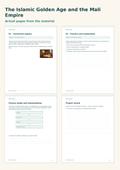
The unit has eight lessons, and each lesson has three pages: an explanation page, a practice and explanation page, and a case card. The first three lessons cover connected regions, translation and scholarship, and learning institutions. The unit then moves to West Africa with Mali and trade, Mansa Musa and Timbuktu, followed by a lesson on culture and power. The last lesson, Historical claims, asks students to test statements about the past against evidence. The unit works with two example regions and does not cover all of Islamic or West African history. A precise model page, two vocabulary pages, a learning check and a project close the unit.
What's Included
- Classroom Material: 33 pages (PDF)
- Teacher Guide: 13 pages (PDF) with answers, teaching notes and assessment feedback
- Editable DOCX text editions of the classroom material and the teacher guide
- Presentation with 17 slides
- Original illustrations and model diagrams; digital download
The 8 Lessons
- Lesson 1: Connected regions – Students follow how trade routes, language and belief linked distant regions.
- Lesson 2: Translation and scholarship – Students look at how texts were translated, compared and passed on.
- Lesson 3: Learning institutions – Students look at places of learning and ask who had access to knowledge.
- Lesson 4: Mali and trade – Students explain how trade supported and connected an empire.
- Lesson 5: Mansa Musa – A ruler serves as a case study of power, wealth and reputation.
- Lesson 6: Timbuktu – Students study the city as a place of trade and learning.
- Lesson 7: Culture and power – Students ask how culture and political power supported each other.
- Lesson 8: Historical claims – Students test statements about the past against the evidence.
- Check and Project – A learning check, two vocabulary pages, a project brief, a project record and a reflection page.
Students Will Learn To
- Explain how trade and shared knowledge connected distant regions
- Describe how scholars translated, compared and passed on texts
- Explain how trade shaped the Mali Empire
- Connect culture, learning and political power in Mansa Musa and Timbuktu
- Test a historical claim against evidence and say where it stays open
Perfect For
- Grade 7 social studies and world history teachers
- Bilingual, CLIL and international school classes working in English
- Teachers who want a closed unit or single lessons, since each lesson stands on its own
- Classes that need practice explaining a position with evidence
- UK and Australia: roughly Year 8
Why Teachers Choose This Unit
- A separate teacher guide with answers and teaching notes for each of the eight lessons
- An assessment key with feedback notes and a differentiation and observation page
- Tasks move from explanations and worked examples to supported practice and then to case cards that require reasoning
- Two vocabulary pages support students who are still building subject terms
- Historical claims, the final lesson, brings together the evidence method used across the unit
Every resource is built around the curriculum you teach – and if something doesn't fit your standards, the TeachLessons Guarantee applies: we adapt it for you.
Created with AI assistance. Texts and illustrations were generated with AI support and edited for classroom use; sources and production notes are at the end of the teacher guide.
Frequently Asked Questions
Which grades and standards does this fit?
The unit is written for Grade 7. The closest US framework is the C3 Framework for Social Studies State Standards (history). No alignment or endorsement is claimed.
Are answers included?
Yes. The separate 13-page teacher guide has answers and teaching notes for all eight lessons, an assessment key and differentiation notes.
How long does the unit take?
The material does not state a time frame, so plan by group. Each of the eight lessons is three pages (explanation, practice and explanation, case card), and the lessons are self-contained, so you can teach them in order or pick the ones you need.
Does the unit cover all of Islamic or West African history?
No. It works with two example regions: the Islamic Golden Age in the first three lessons and Mali, Mansa Musa and Timbuktu in the next three. It does not replace a textbook.
$19.99 – buy now
PDF · instant download
🔒 Secure checkout · ♾️ reuse every yearFAQ about this resource
More Social Studies resources for Middle School
Review: The Islamic Golden Age and the Mali Empire | 8 Lessons, 8 Case Card...
The Islamic Golden Age and the Mali Empire | 8 Lessons, 8 Case Cards & a Proj... is a fully worked-out teaching resource for Social Studies at Middle School level (Grades 7). Its strength is that it is finished: worksheets, answer keys and teacher notes are all there, so a lesson can start without extra prep.
Teachers covering a topic at short notice, early-career teachers under planning pressure, and anyone picking up a cover lesson — and any situation where a lesson has to be ready today.
An editorial assessment of structure, scope and classroom use. It is not a customer review.