

✓ Added to cart
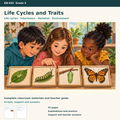

Life Cycles and Inherited Traits | 8 Lessons, Case Cards & a Project | Grade 3
Life Cycles and Inherited Traits | 8 Lessons, Case Cards & a Project | Grade 3
Life Cycles and Inherited Traits is a science unit for Grade 3 with 32 pages of classroom material and a separate 13-page teacher guide. Students compare life-cycle patterns, follow butterfly and flowering plant development, and look at inherited similarities, variation within a group and the influence of the environment. It is written for third grade teachers who want a self-contained NGSS-style unit with explanations, supported practice and reasoning cases.
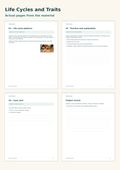
The unit has eight lessons with the same three pages each: an explanation page, a practice page with explanation, and a case card. The first three lessons cover life-cycle patterns, butterfly development and flowering plants. Lessons 4 to 6 turn to inherited similarities, variation within a group and environmental influences. Lesson 7 uses patterns to make predictions, and Lesson 8 asks students to explain with evidence. Two vocabulary pages, a learning check and a short project with a reflection page complete the unit.
What's Included
- Classroom Material: 32 pages (PDF, print edition)
- Teacher Guide: 13 pages (PDF) with answers, case guidance and assessment feedback
- Editable DOCX text editions of the classroom material and the teacher guide
- Presentation with 17 slides (PPTX)
- Original illustrations; the PDF is the print reference and DOCX line breaks may differ
- Vocabulary pages, a learning check and a project with a record and reflection page
The 8 Lessons
- Lesson 1: Life-cycle patterns – Comparing the patterns in life cycles.
- Lesson 2: Butterfly development – Following the stages of butterfly development.
- Lesson 3: Flowering plants – Following the life cycle of a flowering plant.
- Lesson 4: Inherited similarities – Looking at similarities passed from parents to offspring.
- Lesson 5: Variation within a group – Describing differences among members of a group.
- Lesson 6: Environmental influences – Looking at how the environment affects traits.
- Lesson 7: Patterns and predictions – Using patterns to make predictions.
- Lesson 8: Explain with evidence – Explaining an idea with evidence.
Students Will Learn To
- Compare life-cycle patterns across different organisms
- Describe the stages of butterfly and flowering plant development
- Describe inherited similarities and variation within a group
- Explain how the environment can influence traits
- Use patterns to make predictions and explain with evidence
Perfect For
- Grade 3 science teachers who need a closed unit on life cycles and traits
- Teachers who want students to explain with evidence rather than memorize terms
- Classes that need a clear sequence from life cycles to inheritance and variation
- Homeschool families looking for printable lessons with a separate answer guide
- UK and Australia: roughly Year 4
Why Teachers Choose This Unit
- Each lesson follows the same explanation, practice and case card pattern, so students know what to expect
- Butterflies and flowering plants give students two concrete life cycles to compare
- Inheritance, variation and environment are treated in three separate lessons, so none is rushed
- The teacher guide has a teaching concept, sequence and preparation notes, answers for all eight lessons, an assessment key with feedback, and a differentiation and observation chapter
- Editable DOCX text editions allow you to adapt wording for your class
Every resource is built around the curriculum you teach – and if something doesn't fit your standards, the TeachLessons Guarantee applies: we adapt it for you.
Created with AI assistance. Texts and illustrations were generated with AI support and edited for classroom use; sources and production notes are at the end of the teacher guide.
Frequently Asked Questions
Which standards does this fit?
The content is closest to NGSS 3-LS1 (life cycles) and 3-LS3 (inheritance and variation of traits). No alignment or endorsement is claimed.
Are answers included?
Yes. The separate 13-page teacher guide has answers and teaching notes for all eight lessons and an assessment key with feedback.
How long does the unit take?
The material does not state a duration. Plan by lesson: each has three pages, and you can use the lessons in order or choose the ones you need.
Which life cycles does the unit use?
Lesson 2 follows butterfly development and Lesson 3 follows flowering plants. Lesson 1 first compares life-cycle patterns in general.
$19.99 – buy now
PDF · instant download · 32 pages
🔒 Secure checkout · ♾️ reuse every yearFAQ about this resource
More Science resources for Elementary School


Review: Life Cycles and Inherited Traits | 8 Lessons, Case Cards & a Projec...
Life Cycles and Inherited Traits | 8 Lessons, Case Cards & a Project | Grade 3 is a fully worked-out teaching resource for Science at Elementary School level (Grades 3). Its strength is that it is finished: worksheets, answer keys and teacher notes are all there, so a lesson can start without extra prep.
Teachers covering a topic at short notice, early-career teachers under planning pressure, and anyone picking up a cover lesson — and any situation where a lesson has to be ready today.
An editorial assessment of structure, scope and classroom use. It is not a customer review.