

✓ Added to cart


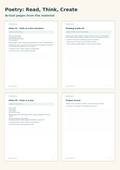
Poetry: Read, Think, Create | 6 Lessons, 12 Poems & Reading Studios | Grades 6–8
Poetry: Read, Think, Create | 6 Lessons, 12 Poems & Reading Studios | Grades 6–8
Poetry: Read, Think, Create is a grades 6–8 poetry unit with 50 pages of classroom material and a separate 23-page teacher guide. It covers twelve short public-domain poems, close reading, sound, comparison and writing. Seven poems are by Emily Dickinson and five are by Robert Louis Stevenson. It is written for middle school English teachers and homeschool families who want a poetry unit that includes the poems themselves.
The unit has two parts that work together. First, each of the twelve poems gets its own poem page and a reading studio page, where students build and test an interpretation. Second, six lessons teach the skills, and each one uses the same three pages: an explanation page, a practice page with explanation, and a case card. The lessons cover speaker and author, sound and rhythm, image and figurative language, line breaks and turns, comparing poems with a purpose, and writing and revising a poem. Two vocabulary pages, a learning check, a short project with a record page and a reflection page complete the unit.
What's Included
- Classroom Material: 50 pages (PDF, print edition)
- Teacher Guide: 23 pages (PDF) with answers, case guidance and assessment feedback
- Twelve poem pages and twelve reading studio pages, with reading notes for each poem in the teacher guide
- Editable DOCX text editions of the classroom material and the teacher guide
- Presentation with 17 slides (PPTX)
- Original illustrations; the PDF is the print reference and DOCX line breaks may differ
The 6 Lessons
- Lesson 1: Speaker and author – Students separate the speaker of a poem from the person who wrote it.
- Lesson 2: Sound and rhythm – Learners listen for sound patterns and rhythm and say what they add.
- Lesson 3: Image and figurative language – Students read images and figurative language for meaning.
- Lesson 4: Line breaks and turns – Learners look at how line breaks and turns shape a poem.
- Lesson 5: Compare with a purpose – Students compare poems to answer a clear question.
- Lesson 6: Write and revise – Learners write a poem and revise it with the techniques they studied.
Students Will Learn To
- Tell the speaker of a poem from its author
- Describe how sound and rhythm contribute to meaning
- Read images and figurative language closely
- Explain how line breaks and turns shape a poem
- Compare poems with a purpose, then write and revise their own
Perfect For
- Grade 6–8 English teachers who want a poetry unit with the poems included
- Teachers who want practice in close reading and supported interpretation
- Poetry units, centers and small-group work in a mixed middle school class
- Homeschool families looking for printable lessons with a separate answer guide
- UK and Australia: roughly Years 7 to 9
Why Teachers Choose This Unit
- The twelve poems are included in the unit, so no separate anthology is needed
- Every poem has a reading studio page for building and testing an interpretation
- The six skill lessons follow the same explanation, practice and case card pattern
- The teacher guide has reading notes for each poem, an assessment key with feedback and a differentiation and observation chapter
- The editable DOCX text editions let you adjust wording for your class
Every resource is built around the curriculum you teach – and if something doesn't fit your standards, the TeachLessons Guarantee applies: we adapt it for you.
Created with AI assistance. Texts and illustrations were generated with AI support and edited for classroom use; sources and production notes are at the end of the teacher guide.
Frequently Asked Questions
Which standards does this fit?
The content is closest to the CCSS reading standards for literature at grades 6–8 (CCSS RL.6–8), including figurative language, structure and comparison, and the writing standards. No alignment or endorsement is claimed.
Are answers included?
Yes. The separate 23-page teacher guide has reading notes for all twelve poems, answers and teaching notes for the six lessons, an assessment key with feedback, and a chapter on differentiation and observation.
How long does the unit take?
The material does not state a duration. Plan by lesson and by poem: each lesson has three pages, and each poem has a poem page and a reading studio page.
Which poets are included?
The unit has twelve short public-domain poems: seven by Emily Dickinson and five by Robert Louis Stevenson. The poem titles are listed in the unit's page plan.
$29.99 – buy now
PDF · instant download · 50 pages
🔒 Secure checkout · ♾️ reuse every yearFAQ about this resource
More Reading & Phonics resources for Middle School


Review: Poetry: Read, Think, Create | 6 Lessons, 12 Poems & Reading Studios...
Poetry: Read, Think, Create | 6 Lessons, 12 Poems & Reading Studios | Grades 6–8 is a fully worked-out teaching resource for Reading & Phonics at Middle School level (Grades 6–8). Its strength is that it is finished: worksheets, answer keys and teacher notes are all there, so a lesson can start without extra prep.
Teachers covering a topic at short notice, early-career teachers under planning pressure, and anyone picking up a cover lesson — and any situation where a lesson has to be ready today.
An editorial assessment of structure, scope and classroom use. It is not a customer review.