

✓ Added to cart

Earth and Space: Solar System, Seasons & Moon Phases | 8 Lessons, 6 Model Labs | Grades 6–8
Earth and Space: Solar System, Seasons & Moon Phases | 8 Lessons, 6 Model Labs | Grades 6–8
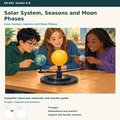
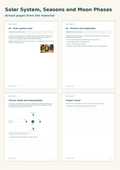
Earth and Space: Solar System, Seasons and Moon Phases is a science unit for Grades 6–8 with 47 pages of classroom material and a separate 23-page teacher guide. Students work on solar-system scale, gravity and orbits, rotation and revolution, seasons, moon phases, eclipses, and how models are tested against evidence. It is written for middle school science teachers who want a self-contained earth and space unit with explanations, worked examples, supported practice and reasoning cases.
The unit has eight lessons with the same three pages each: an explanation page, a practice page with explanation, and a case card. The first lessons set scale and motion: distances in the solar system, gravity and orbits, then rotation and revolution. Seasons follow, explained with a model. Moon phases form the second focus, with one lesson on how phases arise and one on their order, before eclipses and a closing lesson on models and evidence. Six model labs give students something to build and observe, and four task pairs on the Moon each ask for a justification and then a revision. A learning check and a short project with a reflection page close the unit.
What's Included
- Classroom Material: 47 pages (PDF, print edition)
- Teacher Guide: 23 pages (PDF) with answers, case guidance and assessment feedback
- Editable DOCX text editions of the classroom material and the teacher guide
- Presentation with 17 slides (PPTX)
- Original illustrations and model diagrams; the PDF is the print reference and DOCX line breaks may differ
- Six model labs and four moon-phase task pairs, all with keys in the teacher guide
The 8 Lessons
- Lesson 1: Solar-system scale – Comparing distances and sizes in the solar system.
- Lesson 2: Gravity and orbits – Gravity as the reason objects stay in orbit.
- Lesson 3: Rotation and revolution – Telling apart spinning on an axis and moving around the Sun.
- Lesson 4: Seasons – Explaining the seasons with a model.
- Lesson 5: Moon phases – Describing how the Moon's phases come about.
- Lesson 6: Phase sequence – Ordering the phases and justifying the order.
- Lesson 7: Eclipses – Treating solar and lunar eclipses as questions of alignment.
- Lesson 8: Models and evidence – Testing a model against evidence and naming its limits.
Students Will Learn To
- Compare distances and sizes in the solar system using a scale model
- Explain how gravity keeps objects in orbit
- Distinguish rotation from revolution and use both to explain day, night and the seasons
- Describe how moon phases arise and put the phases in order with a justification
- Evaluate a model by checking it against evidence and stating where it stops working
Perfect For
- Grades 6–8 science teachers who need a closed earth and space unit
- Teachers who want hands-on model labs paired with written reasoning
- Classes that need extra work on moon phases and the reasons behind them
- Homeschool families looking for printable lessons with a separate answer guide
- UK and Australia: roughly Years 7 to 9
Why Teachers Choose This Unit
- Six model labs cover distance, day and night, tilt, phases, eclipse alignment and an evidence journal
- Four task pairs on the Moon each ask students to justify an answer and then revise it
- Every lesson follows the same explanation, practice and case card pattern
- The teacher guide has answers for all eight lessons, keys for the labs and task pairs, an assessment key with feedback, and a differentiation and observation chapter
- A closing lesson on models and evidence asks students what a model can and cannot show
Every resource is built around the curriculum you teach – and if something doesn't fit your standards, the TeachLessons Guarantee applies: we adapt it for you.
Created with AI assistance. Texts and illustrations were generated with AI support and edited for classroom use; sources and production notes are at the end of the teacher guide.
Frequently Asked Questions
Which standards does this fit?
The content is closest to NGSS MS-ESS1 (Earth's place in the universe). No alignment or endorsement is claimed.
Are answers included?
Yes. The separate 23-page teacher guide has answers for all eight lessons, keys for the six model labs and four moon-phase task pairs, and an assessment key with feedback.
How long does the unit take?
The material does not state a duration. Plan by lesson and by lab: each lesson has three pages, and you can use the model labs and task pairs where they suit your class.
Which moon phases are covered?
New and full Moon, the quarter phases, and the waxing and waning phases, each with a task that asks students to justify and then revise their answer.
$24.99 – buy now
PDF · instant download
🔒 Secure checkout · ♾️ reuse every yearFAQ about this resource
More Earth & Space Science resources for Middle School


Review: Earth and Space: Solar System, Seasons & Moon Phases | 8 Lessons, 6...
Earth and Space: Solar System, Seasons & Moon Phases | 8 Lessons, 6 Model Lab... is a fully worked-out teaching resource for Earth & Space Science at Middle School level (Grades 6–8). Its strength is that it is finished: worksheets, answer keys and teacher notes are all there, so a lesson can start without extra prep.
Teachers covering a topic at short notice, early-career teachers under planning pressure, and anyone picking up a cover lesson — and any situation where a lesson has to be ready today.
An editorial assessment of structure, scope and classroom use. It is not a customer review.