✓ Added to cart

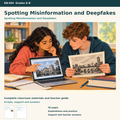
Spotting Misinformation and Deepfakes | 8 Lessons, 6 Verification Files & a Project | Grades 6–8
Spotting Misinformation and Deepfakes | 8 L...
$19.99
✓ Download link is ready the moment you check out.
🔒 Secure checkout · Instant download · Reusable classroom license
Spotting Misinformation and Deepfakes | 8 Les...
$19.99
📄 PDF + Slides
Spotting Misinformation and Deepfakes | 8 Lessons, 6 Verification Files & a Project | Grades 6–8
TeachLessons
📱 Media & Digital Literacy
Spotting Misinformation and Deepfakes | 8 Lessons, 6 Verificat...
Approx.: US Grades 6–8 · UK (England) Years 7–9 · AU Years 6–8 · CA Grades 6–8 · NZ Years 7–9. Regional entry ages and curricula vary, especially Québec and other UK nations. Worldwide use; 24/7 support for help and adaptation requests.
🖨️
Print
& digital
🎓
Grades 6–8
Grade level
⚡
Instant
Download
✅
Standards
Adaptable
Differentiated tasks for mixed-ability classes
Answer keys and teacher notes included
PDF plus slides for projection
Buy once, reuse every school year
Answer KeyDigital LiteracyGrade 6Grade 7Grade 8
$19.99
Instant download
teachlessons.us
Spotting Misinformation and Deepfakes | 8 Lessons, 6 Verification Files & a Project | Grades 6–8
📱
Facts
📱 Media & Digital Literacy 🎓 Middle School · Grades 6–8

Spotting Misinformation and Deepfakes | 8 Lessons, 6 Verification Files & a Project | Grades 6–8

Approx.: US Grades 6–8 · UK (England) Years 7–9 · AU Years 6–8 · CA Grades 6–8 · NZ Years 7–9. Regional entry ages and curricula vary, especially Québec and other UK nations. Worldwide use; 24/7 support for help and adaptation requests.
⭐⭐⭐⭐⭐
Trusted by 10,000+ teachers in the US, UK and Australia · 4.9 / 5 · 98% would recommend
$19.99
One-time payment · no subscription · taxes calculated at checkout
⚡ Instant download 🖨️ Print-ready 📊 Slides included✏️ Editable files🎯 Differentiated✅ Answer keys📋 Assessment included
📦 What you get
Ready-to-teach Media & Digital Literacy resource as a downloadable PDF
Differentiated student worksheets for mixed-ability classes
Answer keys and teacher guidance so you can mark in minutes
Slide deck for whiteboard, projector or remote teaching
Sent to your inbox and stored in your account right after checkout
Buy once, use it with all your own classes, every year
🔒 Secure checkout
⚡ Instant download
🌍 US · UK · AU friendly
♾️ Reusable license
💳 Card🅿️ PayPal🍎 Apple Pay🔵 Shop Pay💳 G Pay
⚡
Instant download – your files arrive by email seconds after checkout
💾
Always available – re-download any time from your account
🌍
Works in US, UK and Australian classrooms – Approx.: US Grades 6–8 · UK (England) Years 7–9 · AU Years 6–8 · CA Grades 6–8 · NZ Years 7–9. Regional entry ages and curricula vary, especially Québec and other UK nations. Worldwide use; 24/7 support for help and adaptation requests.
Product description

Spotting Misinformation and Deepfakes | 8 Lessons, 6 Verification Files & a Project | Grades 6–8

Spotting Misinformation and Deepfakes is a printable media literacy unit for grades 6–8. It teaches students how to check a claim, find the original context of an image or quote, and recognize synthetic media. The classroom material has 39 pages and the separate teacher guide has 19 pages with answers. It is written for middle school teachers in media literacy, English language arts and social studies, and for advisory or technology classes. The unit teaches checking strategies, not the features of individual apps or platforms.

The unit has eight lessons. Lessons 1 to 3 build the basic habits: separating claims from evidence, lateral reading and tracing original context. Lessons 4 to 6 cover common patterns of deception: synthetic media, emotional pressure and bots or coordinated behavior. Lesson 7 looks at numbers and surveys in context, and lesson 8 asks how to correct false information without embarrassing anyone. Each lesson has an explanation page, a practice page and a case card. Six verification files give students cases to work through, and a precise model page, two vocabulary pages, a learning check and a project close the unit.

What's Included

  • Classroom Material: 39 pages (PDF)
  • Teacher Guide: 19 pages (PDF), with expected responses, case guidance and assessment feedback
  • Presentation with 17 slides
  • Editable DOCX text editions of the classroom and teacher material
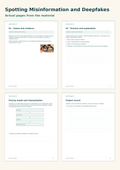
  • Real-page previews that show the actual layout
  • Original illustrations and exact model diagrams

The 8 Lessons

  • Lesson 1: Claims and evidence – Separating a claim from the evidence offered for it.
  • Lesson 2: Lateral reading – Judging a source by asking what other sources say about it.
  • Lesson 3: Original context – Finding where an image or statement came from and what surrounded it.
  • Lesson 4: Synthetic media – Artificially generated content and clues to where it came from.
  • Lesson 5: Emotional pressure – Spotting content designed to trigger a strong feeling.
  • Lesson 6: Bots and coordination – Coordinated behavior that makes agreement look larger than it is.
  • Lesson 7: Numbers in context – Reading numbers and survey results with their context.
  • Lesson 8: Correcting responsibly – Correcting false information factually and without shaming people.
  • Verification files 1 to 6 – Timetable rumor, crowd image, health miracle, survey headline, synthetic announcement and old policy.
  • Check and project – Precise model page, vocabulary, learning check, project brief and record, and a reflection page.

Students Will Learn To

  • Separate a claim from the evidence given for it
  • Check a source by reading laterally across other sources
  • Trace an image or quote back to its original context
  • Recognize clues that content may be synthetic or built to cause a strong reaction
  • Correct false information in a factual and respectful way

Perfect For

  • Grades 6–8 media literacy, English language arts and social studies
  • Advisory and technology classes that teach checking strategies
  • International schools and bilingual programs that teach in English
  • Teachers who want an answer key and a presentation ready for preparation
  • UK and Australia: roughly Years 7 to 9

Why Teachers Choose This Unit

  • The teacher guide has an answer key for each of the eight lessons and for all six verification files
  • The unit teaches methods that carry over to new platforms instead of app-specific instructions
  • Six verification files give students separate cases to apply the methods to
  • The last lesson deals with how to correct others, not only how to detect errors
  • The teacher guide includes an assessment key with feedback, a page on differentiation and observation, and a page on sources and AI production

Every resource is built around the curriculum you teach – and if something doesn't fit your standards, the TeachLessons Guarantee applies: we adapt it for you.

Created with AI assistance. Texts and illustrations were generated with AI support and edited for classroom use; sources and production notes are at the end of the teacher guide.

Frequently Asked Questions

Which standards does this unit fit?

The unit is written for grades 6–8. The closest US framework is the Common Core State Standards for English Language Arts, for example RI.6.8, RI.7.8 and RI.8.8 on evaluating claims and evidence. No alignment or endorsement is claimed.

Are answers included?

Yes. The separate 19-page teacher guide has expected responses for all eight lessons, keys for the six verification files, an assessment key with feedback and notes on differentiation.

How long does the unit take?

The brief gives no fixed duration. Plan it by lesson: each of the eight lessons has an explanation page, a practice page and a case card, and the six verification files can be added as needed. The teacher guide has a page on sequence and preparation.

Does the unit show real fake news or deepfakes?

The verification files are practice cases, for example a timetable rumor, a crowd image and a synthetic announcement. Preview them before use to check they suit your class. The health miracle case is a media literacy exercise and gives no medical advice.

STEP 1
Download
Check out and your files land in your inbox and your account within seconds.
STEP 2
Print or project
Print the handouts, open the slides on your board.
STEP 3
Teach
Run the lesson as written and mark it with the answer keys. Reuse it next year.
⭐ Teacher trust
4.9
⭐⭐⭐⭐⭐
Trusted by 10,000+ teachers in the US, UK and Australia
4.9 / 5 · 98% would recommend TeachLessons resources
📋 Resource details
📱
Subject: Media & Digital Literacy
🎓
Grade level: Middle School · Grades 6–8
🌍
Equivalents: Approx.: US Grades 6–8 · UK (England) Years 7–9 · AU Years 6–8 · CA Grades 6–8 · NZ Years 7–9. Regional entry ages and curricula vary, especially Québec and other UK nations. Worldwide use; 24/7 support for help and adaptation requests.
💾
Format: PDF + slides + editable files (instant download)
🖨️
Use: Print, projector, tablet
✅
Standards: Adaptable to US state standards, the UK National Curriculum and the Australian Curriculum
🎯
Differentiation: Multiple levels included
📋
Answer keys: Included
♾️
License: Single teacher, unlimited own classes
🔄
Last reviewed: 2026
📱
⭐ Browse
More Media & Digital Literacy resources
Ready-to-teach material for Middle School

$19.99 – buy now

PDF · instant download

🔒 Secure checkout · ♾️ reuse every year
Frequently asked questions

FAQ about this resource

Your download link is emailed to you the moment checkout completes, usually within seconds. The files also stay in your customer account under Orders, so you can download them again any time.
It is written for Middle School · Grades 6–8. International equivalents: Approx.: US Grades 6–8 · UK (England) Years 7–9 · AU Years 6–8 · CA Grades 6–8 · NZ Years 7–9. Regional entry ages and curricula vary, especially Québec and other UK nations..
The content is written to be curriculum-neutral, so it slots into US state standards, the UK National Curriculum and the Australian Curriculum. Objectives are stated in plain language so you can map them to your own scheme of work in a couple of minutes.
Yes. You get a single-teacher license covering all of your own classs, this year and every year after. Sharing the files with colleagues, uploading them to a public site or reselling them is not allowed — additional teacher licenses are available on request.
A print-ready PDF in US Letter and A4 friendly layout, plus a slide deck for your board or projector, plus editable files so you can adapt the wording. Everything works on paper, on a projector and on tablets.
Yes — answer keys and teacher guidance come with the resource, so marking takes minutes rather than an evening.
Yes. Tasks come at several levels of challenge with scaffolds for students who need support and extensions for those who finish early.
Card, PayPal, Apple Pay, Google Pay and Shop Pay are all available. Prices are shown in your local currency where supported, and any tax or VAT is calculated at checkout. Purchase orders and school invoices are available on request.
The product images show real pages from the download, so you can judge the layout and depth before buying. Since the files are delivered instantly, digital purchases are not refundable — message us before ordering if anything is unclear and we will send you a sample page.
Editorial review

Review: Spotting Misinformation and Deepfakes | 8 Lessons, 6 Verification F...

In short

Spotting Misinformation and Deepfakes | 8 Lessons, 6 Verification Files & a P... is a fully worked-out teaching resource for Media & Digital Literacy at Middle School level (Grades 6–8). Its strength is that it is finished: worksheets, answer keys and teacher notes are all there, so a lesson can start without extra prep.

What stands out
Usable straight away — printing is the only prep
Answer keys and teacher notes are included in full
Several levels of challenge for a mixed-ability class
Worldwide use, with adaptation to your local curriculum
At a glance
Print-ready PDF plus slides
Download link right after checkout, stored in your account
One-time purchase, no subscription, reuse every year
Works in print, on a projector, whiteboard or tablet
Who it suits

Teachers covering a topic at short notice, early-career teachers under planning pressure, and anyone picking up a cover lesson — and any situation where a lesson has to be ready today.

Reviewed by: TeachLessons editorial team · Last reviewed: 2026
An editorial assessment of structure, scope and classroom use. It is not a customer review.