Kentucky's new financial literacy credit: planning spring career units
A planning guide for Kentucky high school teachers building spring units on money, job applications and workplace skills, with questions to settle with your district before January.
Early November is when Kentucky high schools start locking in spring sections. If you have been handed a financial literacy class, a career studies elective or an advisory period with a vague mandate to 'cover job skills,' the next few weeks are your best window to decide what that course will actually look like. Once winter break starts, there is no time left to build it.
The planning has a specific backdrop this year. As of the 2026–27 school year, students who entered grade 9 on or after July 1, 2025 must earn a one-credit financial literacy course under HB 342 (2025), which amended KRS 158.1411. The state's reference document for that work is the Kentucky Academic Standards for Career Studies and Financial Literacy. If your building has not yet settled who teaches the credit, in which grade, and with what materials, you are in a good position to shape the answer.
Settle four questions with your district first
Before you sequence a single lesson, get clear answers from your principal, counselor or district CTE contact. The credit requirement is set at the state level, but the course itself lives in your local schedule, and the people who approve it will decide what counts. A ten-minute conversation now saves you from rebuilding the course in March.
- Which course code and grade level will carry the financial literacy credit in your building
- Whether your class is the credit course itself or a career elective that sits next to it
- How your district wants you to show the connection to the Kentucky Academic Standards for Career Studies and Financial Literacy, so you can check any materials against them yourself
- Whether your course is part of one of the state-approved four-course career pathways run through the KDE Office of Career and Technical Education
Split money skills and job skills into two clear strands
Courses that mix budgeting one day and interview practice the next tend to feel scattered to students. I have had better results running two strands, each in a solid block of several weeks. Students get enough repetition to build real habits, and you get cleaner assessment data.
The money strand works best when it starts with the student's own life: what they spend in a week, what a first paycheck actually leaves after deductions, how a small debt grows when only the minimum gets paid. Keep the math concrete and local. A sample budget built around a part-time job at a store your students know will hold their attention far longer than a generic case study.
The job strand should end with something students can use the same month: a finished résumé, a cover letter for a real posting, a recorded mock interview. Seniors in particular respond when the work has an obvious next step.
For grading, keep a short portfolio for each student with one artifact per unit: a budget, a letter, an email, a slide deck outline. It gives you something concrete to show parents at conferences and makes the end-of-course reflection much easier to write.
A spring sequence you can adapt
Here is one way to order the semester. Treat it as a starting point and shift the weeks to fit your calendar, testing windows and the length of your class periods.
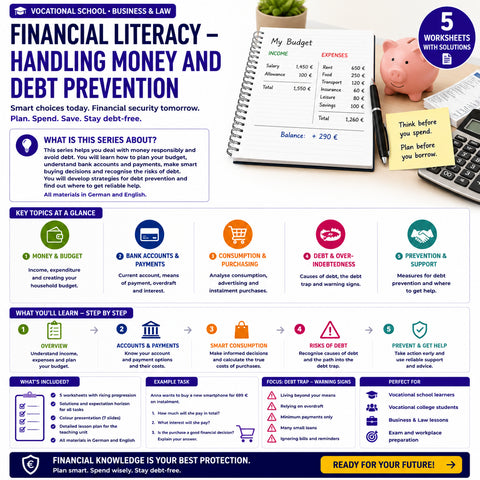
- January: handling money, budgeting and avoiding debt, while holiday spending is still fresh in students' minds
- February: cover letters, résumés and interviews, timed before spring and summer job postings appear
- March: professional email and customer conversations, with role-play that includes a difficult customer
- April: presenting, teamwork and handling conflict in a group project
- May: time management and how AI is changing the kinds of work students will apply for
Using ready units without losing your own voice
Most teachers assigned to a new career course do not have a semester of lessons sitting in a drawer. The Career Readiness Curriculum Bundle gives you eight units in one download ($99.99): financial literacy with debt prevention, application training with cover letter, CV and interview, business letters and professional email, presenting, customer conversations and conflicts, time management and study methods, conflict and team management, and digitalisation and AI in the world of work. You can also buy any single unit and add the others later.
If your building puts more weight on the money side, the Personal Finance Starter Bundle covers a course launch lesson, money values, SMART financial goals and percentages and interest. Neither product is a state-approved course, and neither is presented as meeting the new credit requirement. Lay the units next to the state's career studies and financial literacy standards and your district's course description, and decide what you still need to add.
A practical approach is to keep your own opening and closing for each unit: a local hook at the start and a short reflection at the end. The ready material fills the middle, which is where most of the planning time goes.
Connect your course to the rest of the building
Kentucky graduation also includes a performance-based competency in technology, and many schools fold some of that evidence into career courses. Ask whether your résumé or presentation tasks could serve double duty. If they can, design the rubric with that in mind from the start rather than retrofitting it.
It also helps to talk to the social studies and economics teachers down the hall, since they may already be covering supply and demand or the business cycle. Coordinating avoids teaching the same budget lesson twice in one year. For more Kentucky-specific planning notes, see the page on career readiness for Kentucky high schools, and if you work with feeder schools or have younger students at home, you may find the page on world history units for younger Kentucky learners useful.
Building a spring career or finance course?
Career Readiness Curriculum Bundle (Grades 9–12) →
Kentucky High School Career Readiness: 8 Units From Résumés to AI at Work →
Want a ready-to-teach Economics?A complete Civics curriculum covering government, rights, and civic participation.
Civics Complete (Middle School) →Teaching High School Economics?A complete Civics curriculum covering government, rights, and civic participation.
All High School Curricula →FAQ about TeachLessons resources
Civics Complete covers government, rights, legislation, participation, and current issues in democracy.
It includes lesson plans, document analysis, discussions, simulations, debates, and assessments.
Yes. It supports civic inquiry, source analysis, argumentation, and informed action.
Yes. Complete Curriculum packages currently focus on Middle and High School, while our blog supports Elementary teachers with lesson ideas, classroom strategies, cross-curricular activities, free downloads, and Teach-Life-Balance support.
- Blog articles with practical lesson ideas
- Free resources via the newsletter
- Teach-Life-Balance for teachers at every level
The Teach-Life-Balance course is a time-saving programme for Elementary, Middle, and High School teachers. It helps with lesson planning, marking, admin, routines, boundaries, and workload management.
It includes a teacher planner, guides, templates, and practical strategies. Available at teachlessons.us/products/teach-life-balance.
After purchase you receive an instant email with your download link. Files are also stored in your customer account under Orders. Materials are print-ready PDFs for class, projection, or digital use.
Resources are licensed for personal classroom use. You may use them in your own classes. Sharing digital files or uploading them online is not permitted under a single-user licence. School licences are available on request.
Yes. Although primarily aligned to US standards, the lesson structures and subject content work well for UK and Australian classrooms with minor adaptation. The store supports GBP and AUD currency.
You might also like
Lesson ideas straight to your inbox.
Sign up and get a free starter resource pack plus weekly lesson ideas — no fluff, just things that work in real classrooms.
Almost there, !
Check your inbox and click the confirmation link to receive your free pack.

Comments
No comments yet — be the first to share your thoughts!
Leave a comment
Comments are reviewed before being published.
Thanks for your comment!
Your comment is being reviewed and will appear here shortly.