

✓ Added to cart


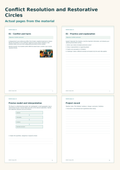
Conflict Resolution and Restorative Circles | 8 Lessons, 4 Facilitator Cases & Project | Grades 6–8
Conflict Resolution and Restorative Circles | 8 Lessons, 4 Facilitator Cases & Project | Grades 6–8
Conflict Resolution and Restorative Circles is a printable unit for grades 6–8. It has 37 pages of classroom material and a separate 17-page teacher guide with answers and case keys. Students learn how conflicts arise, how to lower tension, how to listen, and how a restorative circle is prepared, agreed and followed up. It is written for middle school teachers, advisors and anyone running social-emotional learning lessons. It is classroom teaching material and not mediation or counseling, and it does not replace school counselors or school procedures for violence, bullying or threats.
The unit opens with a short page on how to work with it, where students explain a strategy and use evidence. Eight lessons follow in order, three sections each: an introduction page, a practice and explanation page, and a case card where students solve a task and justify their approach. Four facilitator cases come next: Materials dispute, Targeted threat, Unfinished repair and Rumor. The unit closes with a page on precise models and interpretation, two vocabulary pages, a learning check, a project brief with a project record, and a reflection page. You can work through the lessons in sequence or choose single lessons. A 17-slide presentation supports the introduction and the review.
What's Included
- Classroom Material: 37 pages (PDF, print reference)
- Teacher Guide: 17 pages (PDF) with answers, a separate key for each facilitator case, differentiation and assessment feedback
- Editable DOCX text editions of the classroom material and the teacher guide (page breaks may differ from the PDF)
- Presentation with 17 slides
- Original illustrations and model diagrams
- Sources, model limits and AI disclosure on the last page of the teacher guide
The 8 Lessons and Closing Pages
- Lesson 1: Conflict and harm – Telling a conflict apart from the harm that can follow it.
- Lesson 2: De-escalation – Steps that lower tension.
- Lesson 3: Listening – Active listening practiced as a skill.
- Lesson 4: Restorative questions – Questions that clarify responsibility without blaming.
- Lesson 5: Circle preparation – Preparing a circle conversation, including roles and rules.
- Lesson 6: Repair agreements – Writing agreements that repair harm.
- Lesson 7: Follow-up – Checking later whether an agreement was kept.
- Lesson 8: Reflection without blame – Looking back at what was learned without assigning blame.
- Four facilitator cases – Materials dispute, Targeted threat, Unfinished repair and Rumor, each with its own key in the teacher guide.
- Learning check and project – Learning check, project brief, project record and a reflection and next step page.
Students Will Learn To
- Distinguish conflict from harm
- Use steps that lower tension in a disagreement
- Listen actively and check what they heard
- Ask restorative questions that clarify responsibility without blaming
- Prepare a circle conversation and write and follow up a repair agreement
Perfect For
- Middle school teachers and advisors in grades 6–8
- Social-emotional learning, homeroom or advisory periods and school culture projects
- Teachers who want practice cases rather than work on real incidents in their own class
- Classrooms where students read grade-level English independently or with support
- UK and Australia: roughly Years 7–9
Why Teachers Choose This Unit
- Every lesson has the same three-part structure, so students know what to expect
- Four facilitator cases give practice material, and you decide how closely to relate them to your class
- Each facilitator case has its own key in the teacher guide
- Cases can be chosen in an order that suits the maturity of the group
- The teacher guide includes answers, an assessment key and a page on differentiation and observation
Every resource is built around the curriculum you teach – and if something doesn't fit your standards, the TeachLessons Guarantee applies: we adapt it for you.
Created with AI assistance. Texts and illustrations were generated with AI support and edited for classroom use; sources and production notes are at the end of the teacher guide.
Frequently Asked Questions
Which grades and standards does this fit?
It is written for grades 6–8 (UK Years 7–9). The closest US framework is the CASEL framework for social and emotional learning. No alignment or endorsement is claimed.
Are answers included?
Yes. The separate 17-page teacher guide has expected responses for all eight lessons, a key for each of the four facilitator cases, an assessment key with feedback notes and a page on differentiation and observation.
How long does it take?
The materials do not set a fixed running time. Plan it as eight lessons of three sections each, followed by the facilitator cases, the learning check and the project. You can use the lessons in order or pick single ones.
Does this replace mediation or a school safeguarding process?
No. It is classroom material for practicing conflict resolution, not mediation or counseling. For violence, bullying or threats, follow your school's procedures and contacts. The Targeted threat case should be used only with preparation. The cases are practice cases, not work on real incidents in your class.
$24.99 – buy now
PDF · instant download
🔒 Secure checkout · ♾️ reuse every yearFAQ about this resource
More Social-Emotional Learning resources for Middle School

Review: Conflict Resolution and Restorative Circles | 8 Lessons, 4 Facilita...
Conflict Resolution and Restorative Circles | 8 Lessons, 4 Facilitator Cases ... is a fully worked-out teaching resource for Social-Emotional Learning at Middle School level (Grades 6–8). Its strength is that it is finished: worksheets, answer keys and teacher notes are all there, so a lesson can start without extra prep.
Teachers covering a topic at short notice, early-career teachers under planning pressure, and anyone picking up a cover lesson — and any situation where a lesson has to be ready today.
An editorial assessment of structure, scope and classroom use. It is not a customer review.